Felix Clarke is an English-language author specializing in history, technology, and cultural change. His books explore how innovation, political decisions, and shifting social values shape societies across different eras. His writing style combines detailed research with clear, engaging storytelling, making complex historical and contemporary topics accessible to a broad audience.
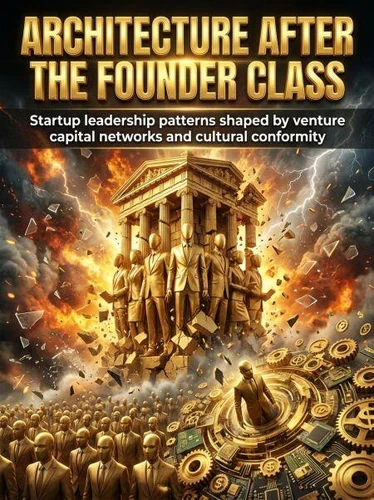
Architecture After the Founder Class. Startup leadership patterns shaped by venture capital networks and cultural conformity
Par :Formats :
Disponible dans votre compte client Decitre ou Furet du Nord dès validation de votre commande. Le format ePub est :
- Compatible avec une lecture sur My Vivlio (smartphone, tablette, ordinateur)
- Compatible avec une lecture sur liseuses Vivlio
- Pour les liseuses autres que Vivlio, vous devez utiliser le logiciel Adobe Digital Edition. Non compatible avec la lecture sur les liseuses Kindle, Remarkable et Sony
 , qui est-ce ?
Notre partenaire de plateforme de lecture numérique où vous retrouverez l'ensemble de vos ebooks gratuitement
Pour en savoir plus sur nos ebooks, consultez notre aide en ligne ici
C'est si simple ! Lisez votre ebook avec l'app Vivlio sur votre tablette, mobile ou ordinateur :

- Nombre de pages182
- FormatePub
- ISBN978-3-565-48255-9
- EAN9783565482559
- Date de parution07/06/2026
- Protection num.pas de protection
- Taille1 Mo
- Infos supplémentairesepub
- ÉditeurEmphaloz Publishing House
Résumé
Startup leadership is often discussed as a meritocratic process driven by innovation and market demand. Yet the modern startup economy increasingly reflects a narrower reality. Venture capital, founder mythology, and cultural conformity have combined into a system where a small group of influential actors shapes what receives funding, visibility, and legitimacy.
This book examines the operating logic behind Silicon Valley's dominant decision-making culture.
Rather than focusing on individual personalities, it analyzes the structures that reward specific behaviors, leadership styles, and strategic assumptions. It explores how venture capital networks reinforce homogeneous thinking across industries. It investigates why startup leadership frequently favors confidence over institutional accountability and why similar growth narratives continue to attract investment despite repeated failures. The analysis also follows the relationship between technology platforms and economic influence.
As founders, investors, and platform operators increasingly occupy overlapping roles, market competition becomes shaped by concentrated power rather than open experimentation. The result is a closer look at how startup ecosystems reproduce themselves through hiring, funding, media attention, and cultural signaling. For European markets, these dynamics raise important questions about innovation sovereignty, regulatory independence, and the long-term consequences of importing governance models designed for a different economic environment.
Rather than focusing on individual personalities, it analyzes the structures that reward specific behaviors, leadership styles, and strategic assumptions. It explores how venture capital networks reinforce homogeneous thinking across industries. It investigates why startup leadership frequently favors confidence over institutional accountability and why similar growth narratives continue to attract investment despite repeated failures. The analysis also follows the relationship between technology platforms and economic influence.
As founders, investors, and platform operators increasingly occupy overlapping roles, market competition becomes shaped by concentrated power rather than open experimentation. The result is a closer look at how startup ecosystems reproduce themselves through hiring, funding, media attention, and cultural signaling. For European markets, these dynamics raise important questions about innovation sovereignty, regulatory independence, and the long-term consequences of importing governance models designed for a different economic environment.