
Felix Clarke is an English-language author specializing in history, technology, and cultural change. His books explore how innovation, political decisions, and shifting social values shape societies across different eras. His writing style combines detailed research with clear, engaging storytelling, making complex historical and contemporary topics accessible to a broad audience.
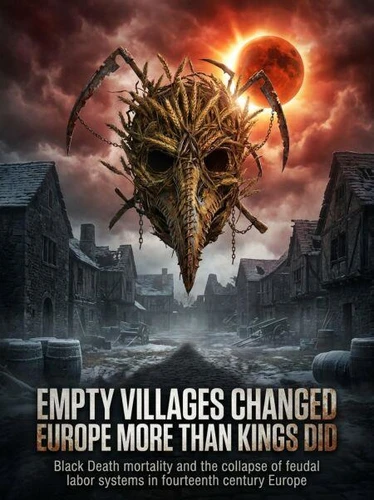
Empty Villages Changed Europe More Than Kings Did. Black Death mortality and the collapse of feudal labor systems in fourteenth century Europe
Par :Formats :
Disponible dans votre compte client Decitre ou Furet du Nord dès validation de votre commande. Le format ePub est :
- Compatible avec une lecture sur My Vivlio (smartphone, tablette, ordinateur)
- Compatible avec une lecture sur liseuses Vivlio
- Pour les liseuses autres que Vivlio, vous devez utiliser le logiciel Adobe Digital Edition. Non compatible avec la lecture sur les liseuses Kindle, Remarkable et Sony
 , qui est-ce ?
Notre partenaire de plateforme de lecture numérique où vous retrouverez l'ensemble de vos ebooks gratuitement
Pour en savoir plus sur nos ebooks, consultez notre aide en ligne ici
C'est si simple ! Lisez votre ebook avec l'app Vivlio sur votre tablette, mobile ou ordinateur :

- Nombre de pages177
- FormatePub
- ISBN978-3-565-47862-0
- EAN9783565478620
- Date de parution05/06/2026
- Protection num.pas de protection
- Taille998 Ko
- Infos supplémentairesepub
- ÉditeurEmphaloz Publishing House
Résumé
The fourteenth century shattered the assumptions holding medieval Europe together. When plague swept across the continent, entire villages disappeared, agricultural production collapsed, and systems of labor that had endured for generations suddenly became unsustainable. Survival itself altered the balance of power between rulers and ordinary people.
This book examines the demographic catastrophe caused by the Black Death and its consequences for feudal society.
The loss of nearly a third of Europe's population destabilized land ownership, taxation, and agricultural production. Labor shortages increased the bargaining power of surviving peasants while weakening traditional aristocratic authority rooted in inherited obligation and controlled rural economies. The narrative also explores the psychological effects of mass mortality. Fear, religious anxiety, and social unrest transformed attitudes toward wealth, faith, and political legitimacy.
Communities struggled to preserve order as institutions proved increasingly unable to respond to recurring waves of disease and economic instability. The fourteenth century emerges here not simply as an era of suffering, but as a turning point in which demographic collapse accelerated the transformation of medieval Europe itself.
The loss of nearly a third of Europe's population destabilized land ownership, taxation, and agricultural production. Labor shortages increased the bargaining power of surviving peasants while weakening traditional aristocratic authority rooted in inherited obligation and controlled rural economies. The narrative also explores the psychological effects of mass mortality. Fear, religious anxiety, and social unrest transformed attitudes toward wealth, faith, and political legitimacy.
Communities struggled to preserve order as institutions proved increasingly unable to respond to recurring waves of disease and economic instability. The fourteenth century emerges here not simply as an era of suffering, but as a turning point in which demographic collapse accelerated the transformation of medieval Europe itself.