Selene Rothwell is a nonfiction author known for writing thoughtful books on psychology, relationships, and emotional well-being. Her reflective style blends modern research with compassionate storytelling, helping readers navigate personal growth and life's uncertainties with greater clarity and resilience.
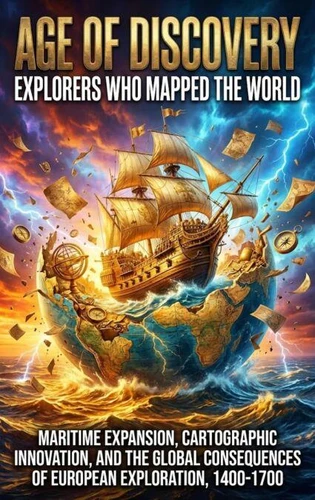
Age of Discovery: Explorers Who Mapped the World. Maritime Expansion, Cartographic Innovation, and the Global Consequences of European Exploration, 1400-1700
Par :Formats :
Disponible dans votre compte client Decitre ou Furet du Nord dès validation de votre commande. Le format ePub est :
- Compatible avec une lecture sur My Vivlio (smartphone, tablette, ordinateur)
- Compatible avec une lecture sur liseuses Vivlio
- Pour les liseuses autres que Vivlio, vous devez utiliser le logiciel Adobe Digital Edition. Non compatible avec la lecture sur les liseuses Kindle, Remarkable et Sony
 , qui est-ce ?
Notre partenaire de plateforme de lecture numérique où vous retrouverez l'ensemble de vos ebooks gratuitement
Pour en savoir plus sur nos ebooks, consultez notre aide en ligne ici
C'est si simple ! Lisez votre ebook avec l'app Vivlio sur votre tablette, mobile ou ordinateur :

- Nombre de pages247
- FormatePub
- ISBN978-3-565-24949-7
- EAN9783565249497
- Date de parution15/02/2026
- Protection num.pas de protection
- Taille2 Mo
- Infos supplémentairesepub
- ÉditeurEmphaloz Publishing House
Résumé
The Age of Discovery transformed global geography, trade networks, and power relations through systematic maritime exploration driven by commercial ambition, technological innovation, and imperial competition. This comprehensive analysis examines how European expeditions mapped previously unknown coastlines, established transoceanic routes, and initiated centuries of colonial expansion-exploring not just famous voyages but the navigational techniques, financial backing, crew experiences, and devastating consequences for indigenous populations.
Drawing on ship logs, cartographic records, merchant correspondence, and indigenous accounts, this book reveals the economic motivations behind exploration, the technological advances that enabled long-distance navigation, and the political rivalries that accelerated territorial claims.
It explores how expeditions were organized and financed, how crews survived months at sea, how knowledge was gathered and contested, and how cartography reflected both discovery and imperial ideology. The narrative examines the impact of European contact on existing civilizations, the establishment of trade monopolies, the beginning of the transatlantic slave trade, and the ecological consequences of biological exchange.
It analyzes how exploration narratives shaped European consciousness while erasing indigenous knowledge systems. Without celebrating conquest, this work provides rigorous analysis of how systematic exploration created the foundations of global imperialism and fundamentally altered human geography.
It explores how expeditions were organized and financed, how crews survived months at sea, how knowledge was gathered and contested, and how cartography reflected both discovery and imperial ideology. The narrative examines the impact of European contact on existing civilizations, the establishment of trade monopolies, the beginning of the transatlantic slave trade, and the ecological consequences of biological exchange.
It analyzes how exploration narratives shaped European consciousness while erasing indigenous knowledge systems. Without celebrating conquest, this work provides rigorous analysis of how systematic exploration created the foundations of global imperialism and fundamentally altered human geography.