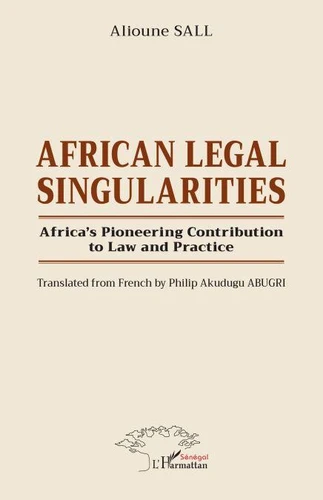
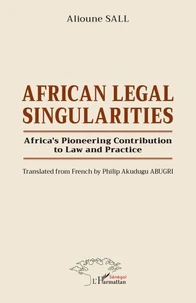
African Legal Singularities. Africa’s Pioneering Contribution to Law and Practice
Par :Formats :
Disponible dans votre compte client Decitre ou Furet du Nord dès validation de votre commande. Le format ePub est :
- Compatible avec une lecture sur My Vivlio (smartphone, tablette, ordinateur)
- Compatible avec une lecture sur liseuses Vivlio
- Pour les liseuses autres que Vivlio, vous devez utiliser le logiciel Adobe Digital Edition. Non compatible avec la lecture sur les liseuses Kindle, Remarkable et Sony
 , qui est-ce ?
Notre partenaire de plateforme de lecture numérique où vous retrouverez l'ensemble de vos ebooks gratuitement
Pour en savoir plus sur nos ebooks, consultez notre aide en ligne ici
C'est si simple ! Lisez votre ebook avec l'app Vivlio sur votre tablette, mobile ou ordinateur :

- Nombre de pages304
- FormatePub
- ISBN978-2-336-50390-5
- EAN9782336503905
- Date de parution19/12/2024
- Protection num.Digital Watermarking
- Taille2 Mo
- Infos supplémentairesepub
- ÉditeurHarmattan Sénégal
- TraducteurPhilip Akudugu Abugri
Résumé
The legal inventiveness of contemporary African societies has not received the attention it deserves. A widespread prejudice too often consists in presenting the rules of law as a kind of artifice condemned to oscillate between mimicry and ineffectiveness, between extroversion and disembodiment. To counter this popular misconception, the author gives ten examples, evoking ten themes touching on major legal issues, in which Africa has created, refined, enriched, or sublimated principles or institutions.
Ten examples through which, while remaining firmly within the realms of modernity, the African continent can certainly claim a kind of precedence and, perhaps, exemplarity. Firmly rejecting any vertical or monopolistic rationale, the book is based on the conviction that the development of law takes place in a horizontal mode of osmosis, hybridisation, and polycentrism. It is an exhortation to look at what is being done elsewhere, an invitation to listen and to explore new horizons.
Ten examples through which, while remaining firmly within the realms of modernity, the African continent can certainly claim a kind of precedence and, perhaps, exemplarity. Firmly rejecting any vertical or monopolistic rationale, the book is based on the conviction that the development of law takes place in a horizontal mode of osmosis, hybridisation, and polycentrism. It is an exhortation to look at what is being done elsewhere, an invitation to listen and to explore new horizons.
A propos de Alioune Sall







40,99 €