
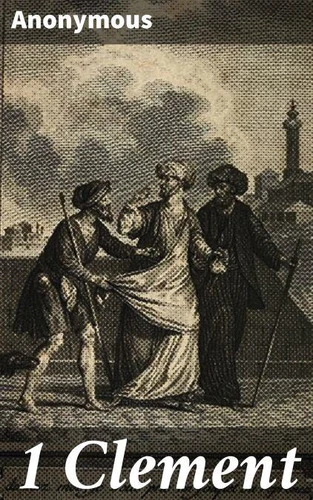
1 Clement. Insights into Early Christian Community and Theology
Par : ,Formats :
Disponible dans votre compte client Decitre ou Furet du Nord dès validation de votre commande. Le format ePub est :
- Compatible avec une lecture sur My Vivlio (smartphone, tablette, ordinateur)
- Compatible avec une lecture sur liseuses Vivlio
- Pour les liseuses autres que Vivlio, vous devez utiliser le logiciel Adobe Digital Edition. Non compatible avec la lecture sur les liseuses Kindle, Remarkable et Sony
 , qui est-ce ?
Notre partenaire de plateforme de lecture numérique où vous retrouverez l'ensemble de vos ebooks gratuitement
Pour en savoir plus sur nos ebooks, consultez notre aide en ligne ici
C'est si simple ! Lisez votre ebook avec l'app Vivlio sur votre tablette, mobile ou ordinateur :

- Nombre de pages35
- FormatePub
- ISBN406-4-06-646507-0
- EAN4064066465070
- Date de parution10/04/2021
- Protection num.Digital Watermarking
- Taille636 Ko
- Infos supplémentairesepub
- ÉditeurGOOD PRESS
Résumé
1 Clement, attributed to an anonymous early Christian author, offers a profound exploration of ecclesiastical authority and community ethics in the nascent Christian church. Written in the late first century, this epistle serves as a letter of encouragement and instruction to the church in Corinth, addressing the issues of division and moral decay. The literary style is characterized by a mixture of rhetorical flourishes, scriptural allusions, and a deep call for unity and reconciliation.
Its theological discussions reflect the early Christian struggle to define authority and maintain communal harmony amid social and spiritual turmoil, making it a pivotal text in early Christian literature. The likely author of 1 Clement was a leader in the Roman church, possibly Clement of Rome himself, whose position in the evolving Christian community may have inspired this epistle. The work embodies the concerns of a community grappling with internal conflict and the need for moral rectitude, indicative of the historical context of early Christian communities striving to flourish in a largely pagan society.
The intent behind the letter was not only pastoral but also political, aiming to preserve the integrity and unity of the faithful. 1 Clement is essential for anyone interested in the formative years of Christianity and the socio-political dynamics of the early church. It provides rich insights into the theological conflicts and resolutions of the time. Scholars, theologians, and lay readers alike will find this text illuminating as it bridges contemporary faith practices with foundational Christian principles.
Its theological discussions reflect the early Christian struggle to define authority and maintain communal harmony amid social and spiritual turmoil, making it a pivotal text in early Christian literature. The likely author of 1 Clement was a leader in the Roman church, possibly Clement of Rome himself, whose position in the evolving Christian community may have inspired this epistle. The work embodies the concerns of a community grappling with internal conflict and the need for moral rectitude, indicative of the historical context of early Christian communities striving to flourish in a largely pagan society.
The intent behind the letter was not only pastoral but also political, aiming to preserve the integrity and unity of the faithful. 1 Clement is essential for anyone interested in the formative years of Christianity and the socio-political dynamics of the early church. It provides rich insights into the theological conflicts and resolutions of the time. Scholars, theologians, and lay readers alike will find this text illuminating as it bridges contemporary faith practices with foundational Christian principles.
A propos de Anonymous

Pistis Sophia
E-book
1,99 €

1,99 €

Greek Folk Tales
E-book
8,99 €
The Bhagavad Gita
E-book
0,49 €

0,49 €

The Dhammapada
E-book
0,49 €
The Upanishads
E-book
0,49 €
The Rig Veda
E-book
0,49 €

Clements Markham
E-book
0,49 €
Sophie Jewett
E-book
0,49 €

Arden of Faversham
E-book
0,49 €

0,49 €
The London Prodigal
E-book
0,49 €
Mucedorus
E-book
0,49 €
Unvoiced Feelings
E-book
2,99 €

Lazarillo de Tormes
E-book
0,49 €

Black Dreams
E-book
6,49 €

0,99 €
