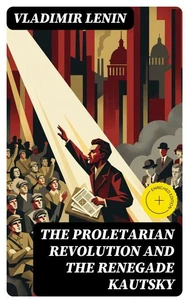
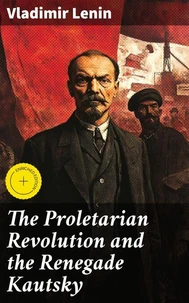
The Proletarian Revolution and the Renegade Kautsky (Summarized Edition). Enriched edition. Marxist critique of socialist reformism and Bolshevik tactics in 20th‑century fights for working-class power
Par : , , ,Formats :
Disponible dans votre compte client Decitre ou Furet du Nord dès validation de votre commande. Le format ePub est :
- Compatible avec une lecture sur My Vivlio (smartphone, tablette, ordinateur)
- Compatible avec une lecture sur liseuses Vivlio
- Pour les liseuses autres que Vivlio, vous devez utiliser le logiciel Adobe Digital Edition. Non compatible avec la lecture sur les liseuses Kindle, Remarkable et Sony
 , qui est-ce ?
Notre partenaire de plateforme de lecture numérique où vous retrouverez l'ensemble de vos ebooks gratuitement
Pour en savoir plus sur nos ebooks, consultez notre aide en ligne ici
C'est si simple ! Lisez votre ebook avec l'app Vivlio sur votre tablette, mobile ou ordinateur :

- Nombre de pages72
- FormatePub
- ISBN859-65--4788324-1
- EAN8596547883241
- Date de parution10/01/2026
- Protection num.Digital Watermarking
- Taille897 Ko
- Infos supplémentairesepub
- ÉditeurQUICKIE CLASSICS
Résumé
Lenin's The Proletarian Revolution and the Renegade Kautsky (1918) is a vehement defense of the October Revolution and the dictatorship of the proletariat against Karl Kautsky's The Dictatorship of the Proletariat. It opposes bourgeois parliamentarism to soviet democracy, justifies the dissolution of the Constituent Assembly, and reads legality through the prism of civil war and imperialist siege.
Combining pamphlet heat with rigorous citation of Marx and Engels, it extends State and Revolution into the concrete problems of holding power. Lenin writes as both theorist and head of a besieged revolutionary government. A veteran of exile and factional struggle in the Second International, editor of Iskra, and author of Imperialism, he had just overseen the seizure of power and the painful Brest-Litovsk peace.
His intimate engagement with Marxist doctrine and the immediate pressures of governance-food shortages, sabotage, the need to centralize authority-inform his insistence that proletarian rule requires new institutions and a break with parliamentary gradualism. Essential reading for students of Marxism, democratic theory, and modern revolutions, this work illuminates the 1917-1918 split in socialism and the meaning of "proletarian democracy, " provoking reflection on strategy, legitimacy, and political form. Quickie Classics summarizes timeless works with precision, preserving the author's voice and keeping the prose clear, fast, and readable-distilled, never diluted.
Enriched Edition extras: Introduction · Synopsis · Historical Context · Author Biography · Brief Analysis · 4 Reflection Q&As · Editorial Footnotes.
Combining pamphlet heat with rigorous citation of Marx and Engels, it extends State and Revolution into the concrete problems of holding power. Lenin writes as both theorist and head of a besieged revolutionary government. A veteran of exile and factional struggle in the Second International, editor of Iskra, and author of Imperialism, he had just overseen the seizure of power and the painful Brest-Litovsk peace.
His intimate engagement with Marxist doctrine and the immediate pressures of governance-food shortages, sabotage, the need to centralize authority-inform his insistence that proletarian rule requires new institutions and a break with parliamentary gradualism. Essential reading for students of Marxism, democratic theory, and modern revolutions, this work illuminates the 1917-1918 split in socialism and the meaning of "proletarian democracy, " provoking reflection on strategy, legitimacy, and political form. Quickie Classics summarizes timeless works with precision, preserving the author's voice and keeping the prose clear, fast, and readable-distilled, never diluted.
Enriched Edition extras: Introduction · Synopsis · Historical Context · Author Biography · Brief Analysis · 4 Reflection Q&As · Editorial Footnotes.