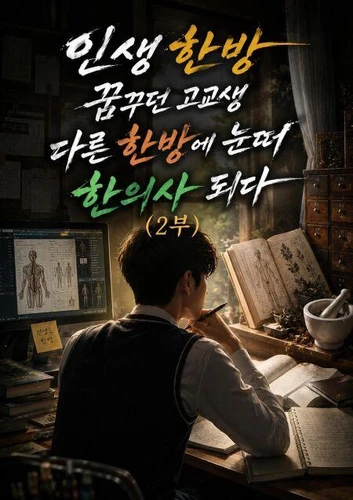
Kangsan Geum's first serious long-term investment has finally paid off. He has been accepted into a college of Korean medicine. The high school student who once dreamed of getting rich through stocks is now a medical student. But admission is only the beginning. There are endless subjects to study, enormous amounts to memorize, and exams that cannot be conquered by intelligence alone. Kangsan responds in the only way he knows.
He calculates the days remaining until each exam, evaluates the difficulty of every subject, measures his level of understanding, and allocates his study time for maximum efficiency. It worked for the entrance exam. Why should medical school be any different?Then he encounters a problem that cannot be solved with a spreadsheet. Textbooks have answers. People do not. Patients with similar symptoms live completely different lives.
The same question can produce entirely different answers. Patients do not organize their stories like textbooks. They do not underline the important information. Sometimes they do not even know which details matter. During his first clinical experiences, Kangsan tries to record everything. His notebook fills with symptoms, timelines, habits, observations, and questions. Then he realizes something simple but important:If he is too busy writing to listen, the notes are meaningless.
Gradually, he begins to look at the patient before looking at his notebook. He learns to notice what people say-and what they do not say. He also learns that observation is not the same as certainty. Seeing something does not give him the right to make assumptions about another person. His questions begin to change. Instead of merely searching for the correct answer, he starts trying to understand the person sitting in front of him.
Then, one day, someone calls him:"Doctor Kangsan."The title that once sounded strange slowly becomes real. As graduation approaches, Kangsan leaves student life behind and begins his first job at a Korean medicine clinic. A new coat. His first patients. Carefully prepared questions. And consultations that refuse to follow his plans. Kangsan instinctively begins calculating again: number of patients, average consultation time, new versus returning patients, and ways to make the process more efficient.
But some things refuse to become numbers. A lonely patient's long conversation. A complaint that cannot be reduced to a simple symptom. A life that cannot fit neatly into a medical chart. The analytical mind that once studied stock charts is now learning to study something far more complicated:people. Kangsan entered medical school searching for a career. Now he must learn how to become a real doctor.
Because there is one lesson no textbook can fully prepare him for:Patients never arrive exactly as the textbook says they will.
Kangsan Geum's first serious long-term investment has finally paid off. He has been accepted into a college of Korean medicine. The high school student who once dreamed of getting rich through stocks is now a medical student. But admission is only the beginning. There are endless subjects to study, enormous amounts to memorize, and exams that cannot be conquered by intelligence alone. Kangsan responds in the only way he knows.
He calculates the days remaining until each exam, evaluates the difficulty of every subject, measures his level of understanding, and allocates his study time for maximum efficiency. It worked for the entrance exam. Why should medical school be any different?Then he encounters a problem that cannot be solved with a spreadsheet. Textbooks have answers. People do not. Patients with similar symptoms live completely different lives.
The same question can produce entirely different answers. Patients do not organize their stories like textbooks. They do not underline the important information. Sometimes they do not even know which details matter. During his first clinical experiences, Kangsan tries to record everything. His notebook fills with symptoms, timelines, habits, observations, and questions. Then he realizes something simple but important:If he is too busy writing to listen, the notes are meaningless.
Gradually, he begins to look at the patient before looking at his notebook. He learns to notice what people say-and what they do not say. He also learns that observation is not the same as certainty. Seeing something does not give him the right to make assumptions about another person. His questions begin to change. Instead of merely searching for the correct answer, he starts trying to understand the person sitting in front of him.
Then, one day, someone calls him:"Doctor Kangsan."The title that once sounded strange slowly becomes real. As graduation approaches, Kangsan leaves student life behind and begins his first job at a Korean medicine clinic. A new coat. His first patients. Carefully prepared questions. And consultations that refuse to follow his plans. Kangsan instinctively begins calculating again: number of patients, average consultation time, new versus returning patients, and ways to make the process more efficient.
But some things refuse to become numbers. A lonely patient's long conversation. A complaint that cannot be reduced to a simple symptom. A life that cannot fit neatly into a medical chart. The analytical mind that once studied stock charts is now learning to study something far more complicated:people. Kangsan entered medical school searching for a career. Now he must learn how to become a real doctor.
Because there is one lesson no textbook can fully prepare him for:Patients never arrive exactly as the textbook says they will.

 , qui est-ce ?