OFFRE LISEUSES
Une liseuse achetée = une housse offerte* jusqu'au 21 juin
- Accueil /
- Urban Croft
Urban Croft

Dernière sortie
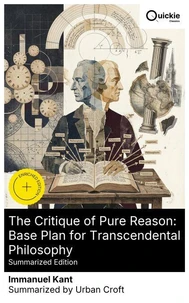
The Critique of Pure Reason: Base Plan for Transcendental Philosophy (Summarized Edition)
Immanuel Kant's The Critique of Pure Reason: Base Plan for Transcendental Philosophy outlines an architectonic program for delimiting human cognition. Through the Transcendental Aesthetic and Analytic, he argues that space and time are forms of intuition and that the categories ground synthetic a priori knowledge, culminating in the transcendental deduction. The Transcendental Dialectic unravels reason's illusions-paralogisms of the soul, antinomies of the world, and the ideal of God-situating metaphysics within critique.
The style is dense, technical, and systematic, bridging rationalist and empiricist legacies under a novel transcendental method. Kant, the Königsberg philosopher shaped by Pietism and Newtonian science, wrote after Hume's skepticism had famously awakened him from dogmatic slumber. Years of teaching logic, metaphysics, and natural philosophy sharpened his attention to the conditions of scientific knowledge.
The 1781 A-edition and 1787 B-edition revisions display his effort to clarify the deduction and present a blueprint for a disciplined metaphysics. This book is indispensable for readers seeking a rigorous map of reason's powers and limits: students of epistemology and metaphysics, historians of ideas, and scientifically minded thinkers. Read slowly, perhaps alongside the Prolegomena or a glossary; the reward is a resilient framework for inquiry that continues to shape philosophical debate. Quickie Classics summarizes timeless works with precision, preserving the author's voice and keeping the prose clear, fast, and readable-distilled, never diluted.
Enriched Edition extras: Introduction · Synopsis · Historical Context · Author Biography · Brief Analysis · 4 Reflection Q&As · Editorial Footnotes.

The style is dense, technical, and systematic, bridging rationalist and empiricist legacies under a novel transcendental method. Kant, the Königsberg philosopher shaped by Pietism and Newtonian science, wrote after Hume's skepticism had famously awakened him from dogmatic slumber. Years of teaching logic, metaphysics, and natural philosophy sharpened his attention to the conditions of scientific knowledge.
The 1781 A-edition and 1787 B-edition revisions display his effort to clarify the deduction and present a blueprint for a disciplined metaphysics. This book is indispensable for readers seeking a rigorous map of reason's powers and limits: students of epistemology and metaphysics, historians of ideas, and scientifically minded thinkers. Read slowly, perhaps alongside the Prolegomena or a glossary; the reward is a resilient framework for inquiry that continues to shape philosophical debate. Quickie Classics summarizes timeless works with precision, preserving the author's voice and keeping the prose clear, fast, and readable-distilled, never diluted.
Enriched Edition extras: Introduction · Synopsis · Historical Context · Author Biography · Brief Analysis · 4 Reflection Q&As · Editorial Footnotes.
Immanuel Kant's The Critique of Pure Reason: Base Plan for Transcendental Philosophy outlines an architectonic program for delimiting human cognition. Through the Transcendental Aesthetic and Analytic, he argues that space and time are forms of intuition and that the categories ground synthetic a priori knowledge, culminating in the transcendental deduction. The Transcendental Dialectic unravels reason's illusions-paralogisms of the soul, antinomies of the world, and the ideal of God-situating metaphysics within critique.
The style is dense, technical, and systematic, bridging rationalist and empiricist legacies under a novel transcendental method. Kant, the Königsberg philosopher shaped by Pietism and Newtonian science, wrote after Hume's skepticism had famously awakened him from dogmatic slumber. Years of teaching logic, metaphysics, and natural philosophy sharpened his attention to the conditions of scientific knowledge.
The 1781 A-edition and 1787 B-edition revisions display his effort to clarify the deduction and present a blueprint for a disciplined metaphysics. This book is indispensable for readers seeking a rigorous map of reason's powers and limits: students of epistemology and metaphysics, historians of ideas, and scientifically minded thinkers. Read slowly, perhaps alongside the Prolegomena or a glossary; the reward is a resilient framework for inquiry that continues to shape philosophical debate. Quickie Classics summarizes timeless works with precision, preserving the author's voice and keeping the prose clear, fast, and readable-distilled, never diluted.
Enriched Edition extras: Introduction · Synopsis · Historical Context · Author Biography · Brief Analysis · 4 Reflection Q&As · Editorial Footnotes.

The style is dense, technical, and systematic, bridging rationalist and empiricist legacies under a novel transcendental method. Kant, the Königsberg philosopher shaped by Pietism and Newtonian science, wrote after Hume's skepticism had famously awakened him from dogmatic slumber. Years of teaching logic, metaphysics, and natural philosophy sharpened his attention to the conditions of scientific knowledge.
The 1781 A-edition and 1787 B-edition revisions display his effort to clarify the deduction and present a blueprint for a disciplined metaphysics. This book is indispensable for readers seeking a rigorous map of reason's powers and limits: students of epistemology and metaphysics, historians of ideas, and scientifically minded thinkers. Read slowly, perhaps alongside the Prolegomena or a glossary; the reward is a resilient framework for inquiry that continues to shape philosophical debate. Quickie Classics summarizes timeless works with precision, preserving the author's voice and keeping the prose clear, fast, and readable-distilled, never diluted.
Enriched Edition extras: Introduction · Synopsis · Historical Context · Author Biography · Brief Analysis · 4 Reflection Q&As · Editorial Footnotes.
Les livres de Urban Croft

Beyond Good and Evil (Summarized Edition). Enriched edition. Aphorisms on Will to Power, Master-Slave Morality, Perspectivism, and the Free Spirit against Christian Morality
Friedrich Nietzsche, Helen Zimmern, Urban Croft
E-book
0,49 €


The Confessions of St. Augustine (Summarized Edition). Enriched edition. A patristic classic of conversion in Roman North Africa—Neoplatonic insight, time, and original sin
Saint Augustine of Hippo, Edward Bouverie Pusey, Urban Croft
E-book
1,99 €

0,49 €