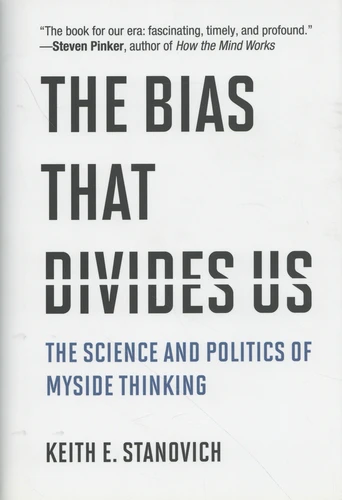
In The Bias That Divides Us, psychologist Keith Stanovich argues provocatively that we don't live in a post-truth society, as has been claimed, but rather a myside society. Our problem is not that we are unable to value and respect truth and facts, but that we are unable to agree on commonly accepted truth and facts. We believe that our side knows the truth. Post-truth ? That describes the other side.
The inevitable result is political polarization. Stanovich shows what science can tell us about myside bias : how common it is, how to avoid it, and what purposes it serves. Stanovich explains that although myside bias is ubiquitous, it is an outlier among cognitive biases. It is unpredictable. Intelligence does not inoculate against it, and myside bias in one domain is not a good indicator of bias shown in any other domain.
Stanovich argues that because of its outlier status, myside bias creates a true blind spot among the cognitive elite - those who are high in intelligence, executive functioning, or other valued psychological dispositions. They may consider themselves unbiased and purely rational in their thinking, but in fact they are just as biased as everyone else. Stanovich investigates how this bias blind spot contributes to our current ideologically polarized politics, connecting it to another recent trend : the decline of trust in university research as a disinterested arbiter.
In The Bias That Divides Us, psychologist Keith Stanovich argues provocatively that we don't live in a post-truth society, as has been claimed, but rather a myside society. Our problem is not that we are unable to value and respect truth and facts, but that we are unable to agree on commonly accepted truth and facts. We believe that our side knows the truth. Post-truth ? That describes the other side.
The inevitable result is political polarization. Stanovich shows what science can tell us about myside bias : how common it is, how to avoid it, and what purposes it serves. Stanovich explains that although myside bias is ubiquitous, it is an outlier among cognitive biases. It is unpredictable. Intelligence does not inoculate against it, and myside bias in one domain is not a good indicator of bias shown in any other domain.
Stanovich argues that because of its outlier status, myside bias creates a true blind spot among the cognitive elite - those who are high in intelligence, executive functioning, or other valued psychological dispositions. They may consider themselves unbiased and purely rational in their thinking, but in fact they are just as biased as everyone else. Stanovich investigates how this bias blind spot contributes to our current ideologically polarized politics, connecting it to another recent trend : the decline of trust in university research as a disinterested arbiter.