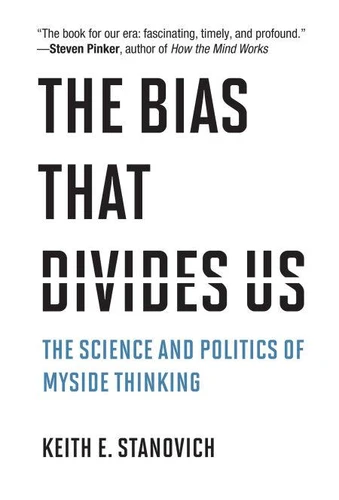
The Bias That Divides Us. The Science and Politics of Myside Thinking
Par :Formats :
Disponible dans votre compte client Decitre ou Furet du Nord dès validation de votre commande. Le format ePub protégé est :
- Compatible avec une lecture sur My Vivlio (smartphone, tablette, ordinateur)
- Compatible avec une lecture sur liseuses Vivlio
- Pour les liseuses autres que Vivlio, vous devez utiliser le logiciel Adobe Digital Edition. Non compatible avec la lecture sur les liseuses Kindle, Remarkable et Sony
- Non compatible avec un achat hors France métropolitaine
 , qui est-ce ?
Notre partenaire de plateforme de lecture numérique où vous retrouverez l'ensemble de vos ebooks gratuitement
Pour en savoir plus sur nos ebooks, consultez notre aide en ligne ici
C'est si simple ! Lisez votre ebook avec l'app Vivlio sur votre tablette, mobile ou ordinateur :

- Nombre de pages256
- FormatePub
- ISBN978-0-262-36523-9
- EAN9780262365239
- Date de parution31/08/2021
- Protection num.Adobe DRM
- Taille731 Ko
- Infos supplémentairesepub
- ÉditeurThe MIT Press
Résumé
A provocative, timely analysis that asks: What does science tells us about the bias that poisons our politics? We don't live in a 'post-truth' society-but a 'myside' society in which no one can agree on accepted truth and facts. In The Bias That Divides Us, psychologist Keith Stanovich argues provocatively that we don't live in a post-truth society, as has been claimed, but rather a myside society.
Our problem is not that we are unable to value and respect truth and facts, but that we are unable to agree on commonly accepted truth and facts. We believe that our side knows the truth. Post-truth? That describes the other side. The inevitable result is political polarization. Stanovich shows what science can tell us about myside bias: how common it is, how to avoid it, and what purposes it serves.
Stanovich explains that although myside bias is ubiquitous, it is an outlier among cognitive biases. It is unpredictable. Intelligence does not inoculate against it, and myside bias in one domain is not a good indicator of bias shown in any other domain. Stanovich argues that because of its outlier status, myside bias creates a true blind spot among the cognitive elite-those who are high in intelligence, executive functioning, or other valued psychological dispositions.
They may consider themselves unbiased and purely rational in their thinking, but in fact they are just as biased as everyone else. Stanovich investigates how this bias blind spot contributes to our current ideologically polarized politics, connecting it to another recent trend: the decline of trust in university research as a disinterested arbiter.
Our problem is not that we are unable to value and respect truth and facts, but that we are unable to agree on commonly accepted truth and facts. We believe that our side knows the truth. Post-truth? That describes the other side. The inevitable result is political polarization. Stanovich shows what science can tell us about myside bias: how common it is, how to avoid it, and what purposes it serves.
Stanovich explains that although myside bias is ubiquitous, it is an outlier among cognitive biases. It is unpredictable. Intelligence does not inoculate against it, and myside bias in one domain is not a good indicator of bias shown in any other domain. Stanovich argues that because of its outlier status, myside bias creates a true blind spot among the cognitive elite-those who are high in intelligence, executive functioning, or other valued psychological dispositions.
They may consider themselves unbiased and purely rational in their thinking, but in fact they are just as biased as everyone else. Stanovich investigates how this bias blind spot contributes to our current ideologically polarized politics, connecting it to another recent trend: the decline of trust in university research as a disinterested arbiter.