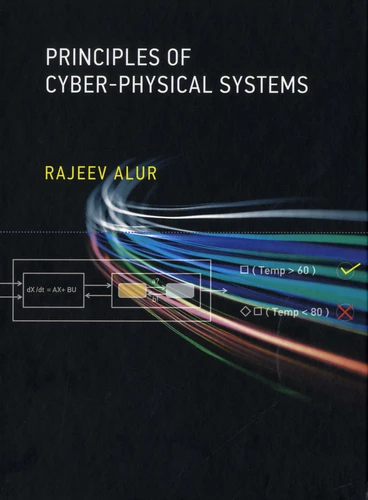
A cyber-physical system consists of a collection of computing devices communicating with one another and interacting with the physical world via sensors and actuators in a feedback loop. Increasingly, such systems are everywhere, from smart buildings to medical devices to automobiles. This textbook offers a rigorous and comprehensive introduction to the principles of design, specification, modeling, and analysis of cyber-physical systems.
The book draws on a diverse set of subdisciplines, including model-based design, concurrency theory, distributed algorithms, formal methods of specification and verification, control theory, real-time systems, and hybrid systems, explaining the core ideas from each that are relevant to system design and analysis. The book explains how formal models provide mathematical abstractions to manage the complexity of a system design.
It covers both synchronous and asynchronous models for concurrent computation, continuous-time models for dynamical systems, and hybrid systems for integrating discrete and continuous evolution. The role of correctness requirements in the design of reliable systems is illustrated with a range of specification formalisms and the associated techniques for formal verification. The topics include safety and liveness requirements, temporal logic, model checking, deductive verification, stability analysis of linear systems, and real-time scheduling algorithms.
Principles of modeling, specification, and analysis are illustrated by constructing solutions to representative design problems from distributed algorithms, network protocols, control design, and robotics. This book provides the rapidly expanding field of cyber-physical systems with a long-needed foundational text by an established authority. It is suitable for classroom use or as a reference for professionals.
A cyber-physical system consists of a collection of computing devices communicating with one another and interacting with the physical world via sensors and actuators in a feedback loop. Increasingly, such systems are everywhere, from smart buildings to medical devices to automobiles. This textbook offers a rigorous and comprehensive introduction to the principles of design, specification, modeling, and analysis of cyber-physical systems.
The book draws on a diverse set of subdisciplines, including model-based design, concurrency theory, distributed algorithms, formal methods of specification and verification, control theory, real-time systems, and hybrid systems, explaining the core ideas from each that are relevant to system design and analysis. The book explains how formal models provide mathematical abstractions to manage the complexity of a system design.
It covers both synchronous and asynchronous models for concurrent computation, continuous-time models for dynamical systems, and hybrid systems for integrating discrete and continuous evolution. The role of correctness requirements in the design of reliable systems is illustrated with a range of specification formalisms and the associated techniques for formal verification. The topics include safety and liveness requirements, temporal logic, model checking, deductive verification, stability analysis of linear systems, and real-time scheduling algorithms.
Principles of modeling, specification, and analysis are illustrated by constructing solutions to representative design problems from distributed algorithms, network protocols, control design, and robotics. This book provides the rapidly expanding field of cyber-physical systems with a long-needed foundational text by an established authority. It is suitable for classroom use or as a reference for professionals.