
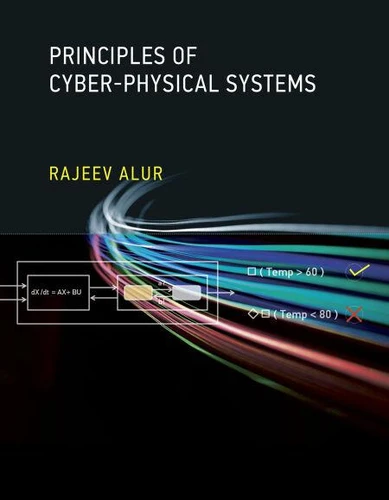
Principles of Cyber-Physical Systems
Par :Formats :
Disponible dans votre compte client Decitre ou Furet du Nord dès validation de votre commande. Le format ePub protégé est :
- Compatible avec une lecture sur My Vivlio (smartphone, tablette, ordinateur)
- Compatible avec une lecture sur liseuses Vivlio
- Pour les liseuses autres que Vivlio, vous devez utiliser le logiciel Adobe Digital Edition. Non compatible avec la lecture sur les liseuses Kindle, Remarkable et Sony
- Non compatible avec un achat hors France métropolitaine
 , qui est-ce ?
Notre partenaire de plateforme de lecture numérique où vous retrouverez l'ensemble de vos ebooks gratuitement
Pour en savoir plus sur nos ebooks, consultez notre aide en ligne ici
C'est si simple ! Lisez votre ebook avec l'app Vivlio sur votre tablette, mobile ou ordinateur :

- Nombre de pages464
- FormatePub
- ISBN978-0-262-32846-3
- EAN9780262328463
- Date de parution24/04/2015
- Protection num.Adobe DRM
- Taille5 Mo
- Infos supplémentairesepub
- ÉditeurThe MIT Press
Résumé
A foundational text that offers a rigorous introduction to the principles of design, specification, modeling, and analysis of cyber-physical systems. A cyber-physical system consists of a collection of computing devices communicating with one another and interacting with the physical world via sensors and actuators in a feedback loop. Increasingly, such systems are everywhere, from smart buildings to medical devices to automobiles.
This textbook offers a rigorous and comprehensive introduction to the principles of design, specification, modeling, and analysis of cyber-physical systems. The book draws on a diverse set of subdisciplines, including model-based design, concurrency theory, distributed algorithms, formal methods of specification and verification, control theory, real-time systems, and hybrid systems, explaining the core ideas from each that are relevant to system design and analysis.
The book explains how formal models provide mathematical abstractions to manage the complexity of a system design. It covers both synchronous and asynchronous models for concurrent computation, continuous-time models for dynamical systems, and hybrid systems for integrating discrete and continuous evolution. The role of correctness requirements in the design of reliable systems is illustrated with a range of specification formalisms and the associated techniques for formal verification.
The topics include safety and liveness requirements, temporal logic, model checking, deductive verification, stability analysis of linear systems, and real-time scheduling algorithms. Principles of modeling, specification, and analysis are illustrated by constructing solutions to representative design problems from distributed algorithms, network protocols, control design, and robotics. This book provides the rapidly expanding field of cyber-physical systems with a long-needed foundational text by an established authority.
It is suitable for classroom use or as a reference for professionals.
This textbook offers a rigorous and comprehensive introduction to the principles of design, specification, modeling, and analysis of cyber-physical systems. The book draws on a diverse set of subdisciplines, including model-based design, concurrency theory, distributed algorithms, formal methods of specification and verification, control theory, real-time systems, and hybrid systems, explaining the core ideas from each that are relevant to system design and analysis.
The book explains how formal models provide mathematical abstractions to manage the complexity of a system design. It covers both synchronous and asynchronous models for concurrent computation, continuous-time models for dynamical systems, and hybrid systems for integrating discrete and continuous evolution. The role of correctness requirements in the design of reliable systems is illustrated with a range of specification formalisms and the associated techniques for formal verification.
The topics include safety and liveness requirements, temporal logic, model checking, deductive verification, stability analysis of linear systems, and real-time scheduling algorithms. Principles of modeling, specification, and analysis are illustrated by constructing solutions to representative design problems from distributed algorithms, network protocols, control design, and robotics. This book provides the rapidly expanding field of cyber-physical systems with a long-needed foundational text by an established authority.
It is suitable for classroom use or as a reference for professionals.