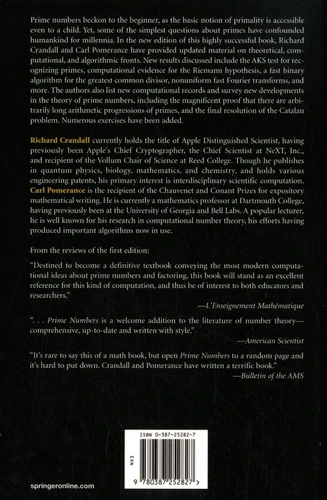
Richard Crandall currently holds the title of Apple Distinguished Scientist, having previously been Apple's Chief Cryptographer, the Chief Scientist at NeXT, Inc., and recipient of the Vollum Chair of Science at Reed College. Though he publishes in quantum physics, biology, mathematics, and chemistry, and holds various engineering patents, his primary interest is interdisciplinary scientific computation.
Carl Pomerance is the recipient of the Chauvenet and Conant Prizes for expository mathematical writing. He is currently a mathematics professor at Dartmouth College, having previously been at the University of Georgia and Bell Labs. A popular lecturer, he is well known for his research in computational number theory, his efforts having produced important algorithms now in use.
Carl Pomerance is the recipient of the Chauvenet and Conant Prizes for expository mathematical writing. He is currently a mathematics professor at Dartmouth College, having previously been at the University of Georgia and Bell Labs. A popular lecturer, he is well known for his research in computational number theory, his efforts having produced important algorithms now in use.