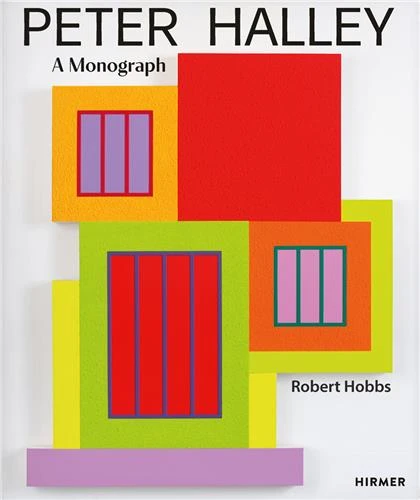
A great deal has been written about Peter Halley's poststructuralist paintings and installations, but no scholar until now has undertaken the task of exploring in depth how Halley's art utilizes the poststructuralist theories of Roland Barthes, Jacques Derrida, Michel Foucault, and Jean Baudrillard. In this first full-scale monograph on Halley's work, noted art historian Robert Hobbs also reveals the vital contradictions at the córe of Halley's project, its way of exploiting tensions between the modern and the postmodern, the visual and the haptic, the real and the hyperreal, while reconciling analogue and digital strategies.
A great deal has been written about Peter Halley's poststructuralist paintings and installations, but no scholar until now has undertaken the task of exploring in depth how Halley's art utilizes the poststructuralist theories of Roland Barthes, Jacques Derrida, Michel Foucault, and Jean Baudrillard. In this first full-scale monograph on Halley's work, noted art historian Robert Hobbs also reveals the vital contradictions at the córe of Halley's project, its way of exploiting tensions between the modern and the postmodern, the visual and the haptic, the real and the hyperreal, while reconciling analogue and digital strategies.