

Valérie Hayaert is a Marie Sklodowska-Curie EUTOPIA-SIF COFUND Fellow at the University of Warwick, Criminal Justice Centre.
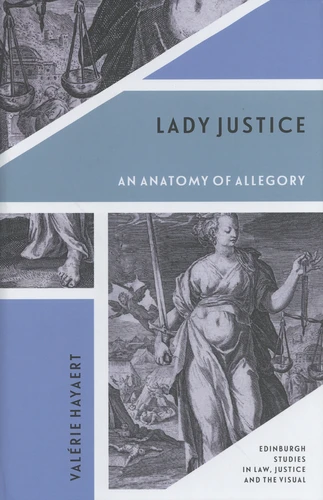
Lady Justice. An Anatomy of Allegory
Par :Formats :
- Paiement en ligne :
- Livraison à domicile ou en point Mondial Relay estimée à partir du 5 octobreCet article sera commandé chez un fournisseur et vous sera envoyé 25 jours après la date de votre commande.
- Retrait Click and Collect en magasin gratuit
- Nombre de pages370
- FormatGrand Format
- PrésentationRelié
- Poids1.035 kg
- Dimensions16,0 cm × 24,0 cm × 2,5 cm
- ISBN978-1-4744-8748-1
- EAN9781474487481
- Date de parution31/10/2023
- CollectionEdinburgh Studies in Law, Just
- ÉditeurEdinburgh University Press
Résumé
Edited by Peter Goodrich and Desmond Manderson, the series Edinburgh Studies in Law, Justice and the Visual explores visual discourses, technologies and theories surrounding the social appearances and political performances of justice, scrupulously attentive to both their historical depth and "With breathtaking erudition and nuance, Hayaert's Lady Justice shows us the historic power -juridical, ethical, affective - of this key allegorical figure.
In Justice's gestures, postures, choreography, her contradictions and enigmas, we find both "the monstrosity of human judgement" and a longing to repair I. estrangement from justice. A major achievement". Julia Stone Peters, Columbia University Dismembering and remembering the sensual and spiritual body of Lady Justice in this wholly novel interpretation. Lady Justice : An Anatomy of Allegory leaves conventional readings of this pivotal figure in European legal history far behind.
Hayaert's study brings together an analysis of thousands of images from the period 1400 -1600, many of them previously overlooked, including artwork, frontispieces, legal texts, sculptures and statues in public spaces and in court buildings scattered across six countries. Lady Justice is taken apart and considered afresh - organ by organ, limb by limb, digit by digit, making a case fora treatment of allegory in all its complexity, ambiguity and affective force.
This unique interdisciplinary study exceeds the iconographic orthodoxy of art historians and the reductive interpretations of legal historians alike. Setting aside styles and schools, ranging widely across time and space, Hayaert identifies Lady Justice as the seat of law's conscience, an archetype of the judge's daimon, and an affective, numinous address to all who, over the course of seven centuries, have found themselves moved by her redolent and inextinguishable presence.
In Justice's gestures, postures, choreography, her contradictions and enigmas, we find both "the monstrosity of human judgement" and a longing to repair I. estrangement from justice. A major achievement". Julia Stone Peters, Columbia University Dismembering and remembering the sensual and spiritual body of Lady Justice in this wholly novel interpretation. Lady Justice : An Anatomy of Allegory leaves conventional readings of this pivotal figure in European legal history far behind.
Hayaert's study brings together an analysis of thousands of images from the period 1400 -1600, many of them previously overlooked, including artwork, frontispieces, legal texts, sculptures and statues in public spaces and in court buildings scattered across six countries. Lady Justice is taken apart and considered afresh - organ by organ, limb by limb, digit by digit, making a case fora treatment of allegory in all its complexity, ambiguity and affective force.
This unique interdisciplinary study exceeds the iconographic orthodoxy of art historians and the reductive interpretations of legal historians alike. Setting aside styles and schools, ranging widely across time and space, Hayaert identifies Lady Justice as the seat of law's conscience, an archetype of the judge's daimon, and an affective, numinous address to all who, over the course of seven centuries, have found themselves moved by her redolent and inextinguishable presence.
A propos de Valérie Hayaert

Echo. Carnets d'atelier (2011-2017)
Beau Livre
59,00 €
22,90 €
Emblematica. Essays in Word and Image Volume 1
Grand Format
72,80 €