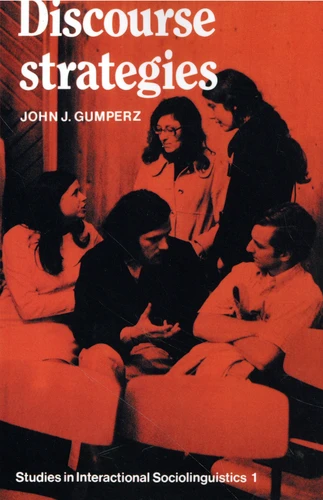
Discourse strategies
Par :Formats :
- Paiement en ligne :
- Livraison à domicile ou en point Mondial Relay estimée à partir du 7 octobreCet article sera commandé chez un fournisseur et vous sera envoyé 25 jours après la date de votre commande.
- Retrait Click and Collect en magasin gratuit
- Nombre de pages225
- FormatGrand Format
- PrésentationBroché
- Poids0.355 kg
- Dimensions13,7 cm × 21,3 cm × 1,5 cm
- ISBN0-521-28896-7
- EAN9780521288965
- Date de parution01/06/2002
- CollectionStudies in Interactional Socio
- ÉditeurCambridge University Press
Résumé
To understand the role of language in public life and the social process in general, we need first a closer understanding of how linguistic knowledge and social factors interact in discourse interpretation. This volume is a major advance towards that understanding. Professor Gumperz here synthesizes fundamental research on communication from a wide variety of disciplines - linguistics, sociolinguistics, anthropology and non-verbal communication - and develops an original and broadly based theory of conversational inference which shows how verbal communication can serve either to reinforce or to overcome the still formidable barriers that exist between individuals of different social and ethnic backgrounds.
The urgent need to overcome such barriers to effective communication is also a central concern of the book. Examples of conversational exchanges as well as of longer encounters, recorded in the urban United States, village Austria, South Asia and Britain, are analyzed to illustrate all aspects of the analytical approach, and to show how subconscious cultural presuppositions can damagingly affect interpretation of intent and judgement of interspeaker attitude.
The volume will be of central interest to anyone concerned with communication, whether from a more academic viewpoint or as professionals working, for example, in the fields of interethnic or industrial relations.
The urgent need to overcome such barriers to effective communication is also a central concern of the book. Examples of conversational exchanges as well as of longer encounters, recorded in the urban United States, village Austria, South Asia and Britain, are analyzed to illustrate all aspects of the analytical approach, and to show how subconscious cultural presuppositions can damagingly affect interpretation of intent and judgement of interspeaker attitude.
The volume will be of central interest to anyone concerned with communication, whether from a more academic viewpoint or as professionals working, for example, in the fields of interethnic or industrial relations.