

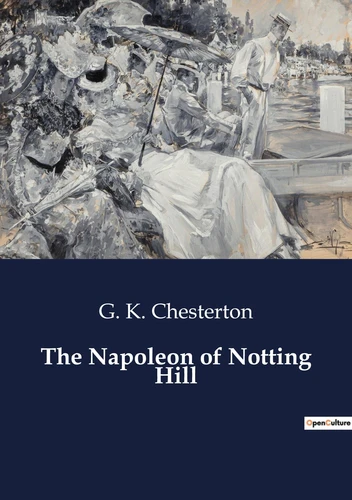
The Napoleon of Notting Hill. A Satirical Exploration of Politics and Society in a Future London
Par :Formats :
- Paiement en ligne :
- Livraison à domicile ou en point Mondial Relay estimée à partir du 18 septembreCet article sera commandé chez un fournisseur et vous sera envoyé 21 jours après la date de votre commande.
- Retrait Click and Collect en magasin gratuit
- Nombre de pages206
- PrésentationBroché
- Poids0.274 kg
- Dimensions14,8 cm × 21,0 cm × 1,1 cm
- ISBN979-10-418-0600-3
- EAN9791041806003
- Date de parution15/06/2023
- ÉditeurCulturea
Résumé
"The Napoleon of Notting Hill" by G. K. Chesterton is a satirical novel set in a future London, where the world has become monotonous and devoid of revolutionary spirit. The story begins with a humorous critique of prophecy and the unpredictability of human behavior. The protagonist, Auberon Quin, is a whimsical and eccentric character who unexpectedly becomes the King of England through a random selection process.
The novel explores themes of nationalism, the absurdity of modern governance, and the clash between individualism and societal norms. Quin's reign is marked by his playful and anarchic approach to change, challenging the rigid and bureaucratic society around him. His antics, including standing on his head in public and engaging in nonsensical conversations, serve as a critique of the dullness and conformity of contemporary life.
The narrative delves into the idea that humor and absurdity can be powerful tools for questioning authority and inspiring change. Through Quin's character, Chesterton examines the tension between tradition and transformation, ultimately suggesting that true progress requires a balance of both. The novel's rich use of language and wit underscores its satirical nature, making it a thought-provoking commentary on the human condition and the nature of power.
The novel explores themes of nationalism, the absurdity of modern governance, and the clash between individualism and societal norms. Quin's reign is marked by his playful and anarchic approach to change, challenging the rigid and bureaucratic society around him. His antics, including standing on his head in public and engaging in nonsensical conversations, serve as a critique of the dullness and conformity of contemporary life.
The narrative delves into the idea that humor and absurdity can be powerful tools for questioning authority and inspiring change. Through Quin's character, Chesterton examines the tension between tradition and transformation, ultimately suggesting that true progress requires a balance of both. The novel's rich use of language and wit underscores its satirical nature, making it a thought-provoking commentary on the human condition and the nature of power.
A propos de G. K. Chesterton


0,99 €
0,99 €

0,99 €
4,99 €

Le bœuf muet
E-book
3,49 €
4,99 €
4,99 €
4,99 €
1,99 €

Le Nommé Jeudi
E-book
0,99 €

4,99 €

L'osteria volante
E-book
5,99 €

5,99 €

2,99 €

5,99 €

B. J. Harrison Reads The Queer Feet
Audiobook
5,99 €