SOLDES
Jusqu'à -70% sur une sélection d'articles*


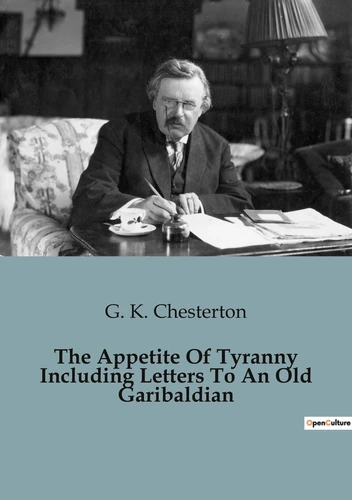
The Appetite Of Tyranny Including Letters To An Old Garibaldian. The Dynamics of Power and Civilization in European Conflict
Par :Formats :
- Paiement en ligne :
- Livraison à domicile ou en point Mondial Relay estimée à partir du 5 aoûtCet article sera commandé chez un fournisseur et vous sera envoyé 21 jours après la date de votre commande.
- Retrait Click and Collect en magasin gratuit
- Livraison à domicile ou en point Mondial Relay estimée à partir du 5 août
- Réservation en ligne avec paiement en magasin :
- Indisponible pour réserver et payer en magasin
- Nombre de pages36
- PrésentationBroché
- Poids0.062 kg
- Dimensions14,8 cm × 21,0 cm × 0,2 cm
- ISBN979-10-419-4708-9
- EAN9791041947089
- Date de parution14/03/2023
- ÉditeurCulturea
Résumé
"The Appetite of Tyranny : Including Letters to an Old Garibaldian" by G. K. Chesterton is a critical examination of the socio-political dynamics leading up to and during World War I, with a particular focus on the role of Prussia. Chesterton argues that Prussia embodies an intermediary form of barbarism, not due to a lack of civilization, but because of its active opposition to the principles that underpin civilized society, such as the sanctity of promises and the concept of reciprocity.
He contrasts this with Russia, which, despite its own flaws, has historically resisted Eastern despotism and supported the liberation of smaller nations. Chesterton critiques the German intellectual and political mindset, which he sees as inherently aggressive and expansionist, driven by a belief in racial superiority and a disregard for international agreements. He highlights the irony in Germany's alliances and actions, which often contradict its professed values.
The text also explores the broader implications of these attitudes for European stability and the moral responsibilities of nations. Through a series of essays, Chesterton dissects the philosophical and ethical underpinnings of the war, ultimately advocating for a defense of democratic and civilized values against the encroaching threat of tyranny.
He contrasts this with Russia, which, despite its own flaws, has historically resisted Eastern despotism and supported the liberation of smaller nations. Chesterton critiques the German intellectual and political mindset, which he sees as inherently aggressive and expansionist, driven by a belief in racial superiority and a disregard for international agreements. He highlights the irony in Germany's alliances and actions, which often contradict its professed values.
The text also explores the broader implications of these attitudes for European stability and the moral responsibilities of nations. Through a series of essays, Chesterton dissects the philosophical and ethical underpinnings of the war, ultimately advocating for a defense of democratic and civilized values against the encroaching threat of tyranny.
A propos de G. K. Chesterton



0,99 €
0,99 €

0,99 €

4,99 €

Le bœuf muet
E-book
3,49 €
4,99 €
4,99 €

4,99 €

0,84 €
0,84 €
0,84 €
6,29 €

Orthodoxy
E-book
5,72 €