
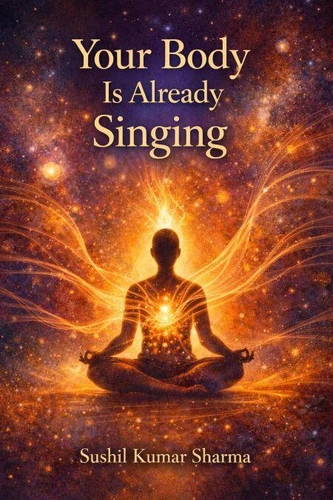
Your Body is Already Singing
Par :Formats :
Disponible dans votre compte client Decitre ou Furet du Nord dès validation de votre commande. Le format ePub est :
- Compatible avec une lecture sur My Vivlio (smartphone, tablette, ordinateur)
- Compatible avec une lecture sur liseuses Vivlio
- Pour les liseuses autres que Vivlio, vous devez utiliser le logiciel Adobe Digital Edition. Non compatible avec la lecture sur les liseuses Kindle, Remarkable et Sony
 , qui est-ce ?
Notre partenaire de plateforme de lecture numérique où vous retrouverez l'ensemble de vos ebooks gratuitement
Pour en savoir plus sur nos ebooks, consultez notre aide en ligne ici
C'est si simple ! Lisez votre ebook avec l'app Vivlio sur votre tablette, mobile ou ordinateur :

- FormatePub
- ISBN8233454608
- EAN9798233454608
- Date de parution12/02/2026
- Protection num.pas de protection
- Infos supplémentairesepub
- ÉditeurLinda Balsamo
Résumé
Your Body Is Already Singing by Sushil Kumar Sharma is a profound and carefully researched exploration of the Svara Adhyaya of the classical treatise Sangita Ratnakara. This book revisits one of the foundational chapters of Indian musicology and presents it in clear, accessible English for the modern reader, while preserving its philosophical depth and technical precision. Rather than treating music as a skill that begins with instruments or training, this work begins at the source.
It examines Nada, the primal principle of sound, and traces its journey from subtle vibration to audible tone. Through a structured and scholarly approach, the book explains the classical distinctions between subtle and struck sound, the emergence of Shruti as microtonal perception, and the crystallization of Svara as meaningful musical tone. Drawing from the original Sanskrit framework, the author guides readers through Sharngadeva's vision of sound as both a physical and conscious phenomenon.
The body is not described as a passive receiver of sound but as its living instrument. Breath, resonance, perception, and awareness are explored in relation to both ancient theory and modern scientific understanding. Without exaggeration or mysticism, the book demonstrates how the human organism continuously participates in sonic activity. Written in a refined yet natural tone, this study bridges classical musicology, philosophy, and physiology.
It speaks to musicians, scholars, and thoughtful readers who wish to understand music not merely as art, but as an expression of order, perception, and embodied intelligence. Your Body Is Already Singing invites readers to reconsider sound as the foundation of communication, cognition, and musical structure. It presents the Svara Adhyaya not as a distant historical text, but as a living inquiry into how sound shapes experience.
Through disciplined scholarship and spiritual sensitivity, the book reveals that before we learn music, before we perform it, we are already immersed in it.
It examines Nada, the primal principle of sound, and traces its journey from subtle vibration to audible tone. Through a structured and scholarly approach, the book explains the classical distinctions between subtle and struck sound, the emergence of Shruti as microtonal perception, and the crystallization of Svara as meaningful musical tone. Drawing from the original Sanskrit framework, the author guides readers through Sharngadeva's vision of sound as both a physical and conscious phenomenon.
The body is not described as a passive receiver of sound but as its living instrument. Breath, resonance, perception, and awareness are explored in relation to both ancient theory and modern scientific understanding. Without exaggeration or mysticism, the book demonstrates how the human organism continuously participates in sonic activity. Written in a refined yet natural tone, this study bridges classical musicology, philosophy, and physiology.
It speaks to musicians, scholars, and thoughtful readers who wish to understand music not merely as art, but as an expression of order, perception, and embodied intelligence. Your Body Is Already Singing invites readers to reconsider sound as the foundation of communication, cognition, and musical structure. It presents the Svara Adhyaya not as a distant historical text, but as a living inquiry into how sound shapes experience.
Through disciplined scholarship and spiritual sensitivity, the book reveals that before we learn music, before we perform it, we are already immersed in it.
A propos de Sushil Kumar Sharma
10,49 €


The Flame of Yoga
E-book
16,49 €

Secrets of Living Energy
E-book
16,49 €
The Origin of Vastu
E-book
17,49 €
10,49 €
10,49 €

8,49 €

7,49 €

Shiva’s Secret Yoga Map
E-book
8,49 €

15,49 €

17,49 €

Om Resonance
E-book
17,49 €
Mind Mastery
E-book
16,49 €

Mudrā Tantra
E-book
17,49 €