SOLDES
Jusqu'à -70% sur une sélection d'articles*

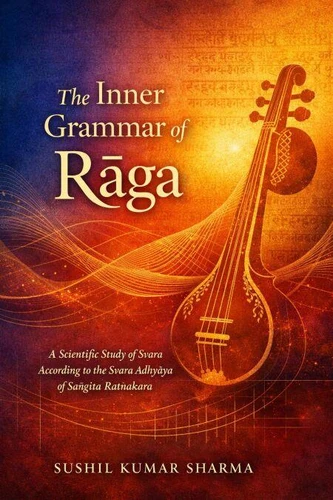
The Inner Grammar of Rāga
Par :Formats :
Disponible dans votre compte client Decitre ou Furet du Nord dès validation de votre commande. Le format ePub est :
- Compatible avec une lecture sur My Vivlio (smartphone, tablette, ordinateur)
- Compatible avec une lecture sur liseuses Vivlio
- Pour les liseuses autres que Vivlio, vous devez utiliser le logiciel Adobe Digital Edition. Non compatible avec la lecture sur les liseuses Kindle, Remarkable et Sony
 , qui est-ce ?
Notre partenaire de plateforme de lecture numérique où vous retrouverez l'ensemble de vos ebooks gratuitement
Pour en savoir plus sur nos ebooks, consultez notre aide en ligne ici
C'est si simple ! Lisez votre ebook avec l'app Vivlio sur votre tablette, mobile ou ordinateur :

- FormatePub
- ISBN8232073985
- EAN9798232073985
- Date de parution03/03/2026
- Protection num.pas de protection
- Infos supplémentairesepub
- ÉditeurDraft2Digital
Résumé
In the architecture of Indian music, sound does not begin as melody. It begins as vibration. The Svara Adhyaya of the Sangita Ratnakara opens not with scales or compositions, but with a profound inquiry into the nature of Nada. This orientation is deliberate. Before a note can be sung, it must be understood as a movement of life itself. The text suggests that music is not an invention of culture but a refinement of an eternal principle.
Nada is described as twofold: the unstruck and the struck. The unstruck sound, known as Anahata, is subtle. It is not produced by friction or impact. It is the latent resonance that underlies consciousness. In spiritual language, it is the inner vibration perceived in deep states of awareness. In experiential terms, it is the hum that seems to arise when the mind becomes still. This concept may appear metaphysical, yet it reflects a refined psychological insight.
The human being is not merely a listener to sound but a field of vibration capable of perceiving inner resonance. The struck sound, known as Ahata, emerges when breath interacts with the body. The Svara Adhyaya traces this emergence through a subtle physiology. Breath moves upward from the navel, gathers force through the heart, and takes form in the throat and head. When air, guided by intention, encounters the vocal apparatus, audible tone arises.
This process is not described mechanically but energetically. Fire, breath, and consciousness collaborate to generate tone. The body becomes an instrument animated by life. This layered view of sound bridges metaphysics and acoustics. Modern science describes vibration as oscillation within a medium. Ancient theory speaks of vibration as the pulse of existence. Both perspectives converge in recognizing movement as the basis of sound.
The distinction lies in emphasis. Science measures frequency. The Svara Adhyaya contemplates meaning. It asks not only how sound is produced but why it moves the heart. In this framework, the note is not a static pitch. It is a living expression of ordered vibration. When vibration stabilizes into a perceivable unit, it becomes Svara. The transformation from raw sound to Svara marks the birth of musical grammar.
It is here that vibration acquires identity. Each Svara embodies a specific placement, a distinct tonal space shaped by subtle intervals. The refinement from noise to tone mirrors the refinement of awareness from distraction to clarity. The spiritual tone of the Svara Adhyaya does not diminish its analytical precision. On the contrary, its metaphysical language coexists with a systematic understanding of pitch and interval.
By grounding musical theory in a philosophy of vibration, the text offers a comprehensive vision. Sound is neither accidental nor arbitrary. It is structured energy capable of shaping emotion and consciousness. To approach Raga through this lens is to recognize that melody rests upon a deeper grammar. Before scales and patterns, there is the science of vibration. Before emotion, there is ordered resonance.
Sound precedes music, and in understanding sound, one begins to glimpse the inner logic that gives Raga its enduring power.
Nada is described as twofold: the unstruck and the struck. The unstruck sound, known as Anahata, is subtle. It is not produced by friction or impact. It is the latent resonance that underlies consciousness. In spiritual language, it is the inner vibration perceived in deep states of awareness. In experiential terms, it is the hum that seems to arise when the mind becomes still. This concept may appear metaphysical, yet it reflects a refined psychological insight.
The human being is not merely a listener to sound but a field of vibration capable of perceiving inner resonance. The struck sound, known as Ahata, emerges when breath interacts with the body. The Svara Adhyaya traces this emergence through a subtle physiology. Breath moves upward from the navel, gathers force through the heart, and takes form in the throat and head. When air, guided by intention, encounters the vocal apparatus, audible tone arises.
This process is not described mechanically but energetically. Fire, breath, and consciousness collaborate to generate tone. The body becomes an instrument animated by life. This layered view of sound bridges metaphysics and acoustics. Modern science describes vibration as oscillation within a medium. Ancient theory speaks of vibration as the pulse of existence. Both perspectives converge in recognizing movement as the basis of sound.
The distinction lies in emphasis. Science measures frequency. The Svara Adhyaya contemplates meaning. It asks not only how sound is produced but why it moves the heart. In this framework, the note is not a static pitch. It is a living expression of ordered vibration. When vibration stabilizes into a perceivable unit, it becomes Svara. The transformation from raw sound to Svara marks the birth of musical grammar.
It is here that vibration acquires identity. Each Svara embodies a specific placement, a distinct tonal space shaped by subtle intervals. The refinement from noise to tone mirrors the refinement of awareness from distraction to clarity. The spiritual tone of the Svara Adhyaya does not diminish its analytical precision. On the contrary, its metaphysical language coexists with a systematic understanding of pitch and interval.
By grounding musical theory in a philosophy of vibration, the text offers a comprehensive vision. Sound is neither accidental nor arbitrary. It is structured energy capable of shaping emotion and consciousness. To approach Raga through this lens is to recognize that melody rests upon a deeper grammar. Before scales and patterns, there is the science of vibration. Before emotion, there is ordered resonance.
Sound precedes music, and in understanding sound, one begins to glimpse the inner logic that gives Raga its enduring power.
A propos de Sushil Kumar Sharma


The Flame of Yoga
E-book
16,49 €


Secrets of Living Energy
E-book
16,49 €
The Origin of Vastu
E-book
17,49 €
10,49 €

8,49 €

8,49 €

7,49 €

Shiva’s Secret Yoga Map
E-book
8,49 €
15,49 €

17,49 €

Om Resonance
E-book
17,49 €
Mind Mastery
E-book
16,49 €

Mudrā Tantra
E-book
17,49 €

Yantra Darśana
E-book
16,49 €
Seed of Creation
E-book
18,49 €