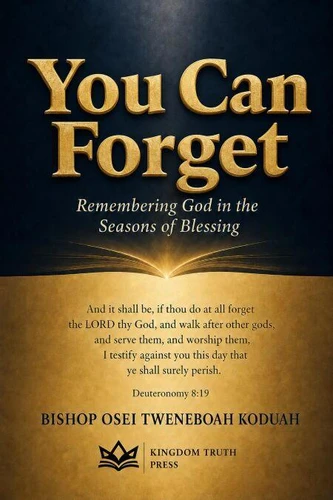
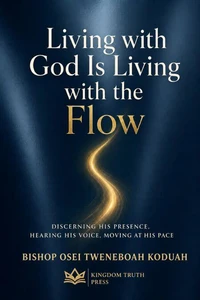
In the wilderness, Israel's daily needs kept them looking to heaven. In the Promised Land, their daily abundance tempted them to look only at their own hands. Deuteronomy 8 warns of a danger far subtler than hardship, the danger of a full house, a fruitful field, and a heart that has quietly stopped saying thank you. Bishop Osei Tweneboah Koduah traces this warning from the wilderness to the modern living room, the modern boardroom, and the modern sanctuary, showing how the very faithful, the very blessed, and the very comfortable are often the ones most at risk of forgetting the God who brought them there.
Across fifteen chapters, this book follows real biblical figures, Israel at the Red Sea, Nebuchadnezzar on his rooftop, Joseph in the palace, the prodigal son in the far country, alongside a cast of ordinary men and women navigating the same drift today. A business owner whose prayer life quietened as her success grew. A husband whose small compromises accumulated into a costly year of rebuilding.
A worship leader who discovered his own ministry had become his idol. Each story is paired with careful, guarded exposition, so that neither prosperity nor hardship is ever mistaken for proof of a heart's true condition. This is not a book about guilt. It is a book about return, written for anyone who senses that the fervor of an earlier season has quietly cooled, and who wants practical, biblically grounded disciplines to bring it back, whatever their current chapter of blessing, waiting, or difficulty looks like.
What You Will Discover. Why witnessing a miracle never guarantees lasting faith, and what to do about it. The seven quiet stages that carry a believer from distraction to bondage, and how to interrupt the drift at any stage. How to tell the difference between a consequence of forgetfulness and an undeserved trial faithfully endured. Why even a sacred calling, a business, or a ministry can quietly become an idol, and how to guard against it. Fifteen daily disciplines that keep remembrance alive long after the crisis that first prompted it has passed. How to build a memorial of God's faithfulness using tools as old as Joshua's stones and as new as a phonePull Quote"You can forget, but you can also choose to remember."
In the wilderness, Israel's daily needs kept them looking to heaven. In the Promised Land, their daily abundance tempted them to look only at their own hands. Deuteronomy 8 warns of a danger far subtler than hardship, the danger of a full house, a fruitful field, and a heart that has quietly stopped saying thank you. Bishop Osei Tweneboah Koduah traces this warning from the wilderness to the modern living room, the modern boardroom, and the modern sanctuary, showing how the very faithful, the very blessed, and the very comfortable are often the ones most at risk of forgetting the God who brought them there.
Across fifteen chapters, this book follows real biblical figures, Israel at the Red Sea, Nebuchadnezzar on his rooftop, Joseph in the palace, the prodigal son in the far country, alongside a cast of ordinary men and women navigating the same drift today. A business owner whose prayer life quietened as her success grew. A husband whose small compromises accumulated into a costly year of rebuilding.
A worship leader who discovered his own ministry had become his idol. Each story is paired with careful, guarded exposition, so that neither prosperity nor hardship is ever mistaken for proof of a heart's true condition. This is not a book about guilt. It is a book about return, written for anyone who senses that the fervor of an earlier season has quietly cooled, and who wants practical, biblically grounded disciplines to bring it back, whatever their current chapter of blessing, waiting, or difficulty looks like.
What You Will Discover. Why witnessing a miracle never guarantees lasting faith, and what to do about it. The seven quiet stages that carry a believer from distraction to bondage, and how to interrupt the drift at any stage. How to tell the difference between a consequence of forgetfulness and an undeserved trial faithfully endured. Why even a sacred calling, a business, or a ministry can quietly become an idol, and how to guard against it. Fifteen daily disciplines that keep remembrance alive long after the crisis that first prompted it has passed. How to build a memorial of God's faithfulness using tools as old as Joshua's stones and as new as a phonePull Quote"You can forget, but you can also choose to remember."