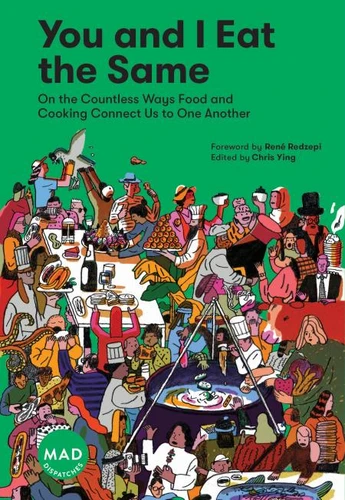
You and I Eat the Same. On the Countless Ways Food and Cooking Connect Us to One Another (MAD Dispatches, Volume 1)
Par : ,Formats :
Disponible dans votre compte client Decitre ou Furet du Nord dès validation de votre commande. Le format ePub protégé est :
- Compatible avec une lecture sur My Vivlio (smartphone, tablette, ordinateur)
- Compatible avec une lecture sur liseuses Vivlio
- Pour les liseuses autres que Vivlio, vous devez utiliser le logiciel Adobe Digital Edition. Non compatible avec la lecture sur les liseuses Kindle, Remarkable et Sony
- Non compatible avec un achat hors France métropolitaine
 , qui est-ce ?
Notre partenaire de plateforme de lecture numérique où vous retrouverez l'ensemble de vos ebooks gratuitement
Pour en savoir plus sur nos ebooks, consultez notre aide en ligne ici
C'est si simple ! Lisez votre ebook avec l'app Vivlio sur votre tablette, mobile ou ordinateur :

- Nombre de pages160
- FormatePub
- ISBN978-1-57965-856-4
- EAN9781579658564
- Date de parution01/10/2018
- Protection num.Adobe DRM
- Infos supplémentairesepub
- ÉditeurArtisan
Résumé
Winner, 2019 IACP Award for Best Book of the Year in Food MattersNamed one of the Best Food Books of the Year by The New Yorker, Smithsonian, The Boston Globe, The Guardian, and moreMAD Dispatches: Furthering Our Ideas About Food Good food is the common ground shared by all of us, and immigration is fundamental to good food. In nineteen thoughtful and engaging essays and stories, You and I Eat the Same explores the ways in which cooking and eating connect us across cultural and political borders, making the case that we should think about cuisine as a collective human effort in which we all benefit from the movement of people, ingredients, and ideas.
An awful lot of attention is paid to the differences and distinctions between us, especially when it comes to food. But the truth is that food is that rare thing that connects all people, slipping past real and imaginary barriers to unify humanity through deliciousness. Don't believe it? Read on to discover more about the subtle (and not so subtle) bonds created by the ways we eat. Everybody Wraps Meat in Flatbread: From tacos to dosas to pancakes, bundling meat in an edible wrapper is a global practice.
Much Depends on How You Hold Your Fork: A visit with cultural historian Margaret Visser reveals that there are more similarities between cannibalism and haute cuisine than you might think. Fried Chicken Is Common Ground: We all share the pleasure of eating crunchy fried birds. Shouldn't we share the implications as well? If It Does Well Here, It Belongs Here: Chef René Redzepi champions the culinary value of leaving your comfort zone.
There Is No Such Thing as a Nonethnic Restaurant: Exploring the American fascination with "ethnic" restaurants (and whether a nonethnic cuisine even exists). Coffee Saves Lives: Arthur Karuletwa recounts the remarkable path he took from Rwanda to Seattle and back again.
An awful lot of attention is paid to the differences and distinctions between us, especially when it comes to food. But the truth is that food is that rare thing that connects all people, slipping past real and imaginary barriers to unify humanity through deliciousness. Don't believe it? Read on to discover more about the subtle (and not so subtle) bonds created by the ways we eat. Everybody Wraps Meat in Flatbread: From tacos to dosas to pancakes, bundling meat in an edible wrapper is a global practice.
Much Depends on How You Hold Your Fork: A visit with cultural historian Margaret Visser reveals that there are more similarities between cannibalism and haute cuisine than you might think. Fried Chicken Is Common Ground: We all share the pleasure of eating crunchy fried birds. Shouldn't we share the implications as well? If It Does Well Here, It Belongs Here: Chef René Redzepi champions the culinary value of leaving your comfort zone.
There Is No Such Thing as a Nonethnic Restaurant: Exploring the American fascination with "ethnic" restaurants (and whether a nonethnic cuisine even exists). Coffee Saves Lives: Arthur Karuletwa recounts the remarkable path he took from Rwanda to Seattle and back again.