
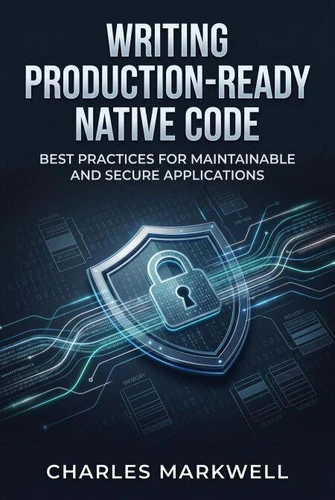
Writing Production-Ready Native Code: Best Practices for Maintainable and Secure Applications. From Writing Native Code to Building Scalable and Maintainable Systems, #1
Par :Formats :
Disponible dans votre compte client Decitre ou Furet du Nord dès validation de votre commande. Le format ePub protégé est :
- Compatible avec une lecture sur My Vivlio (smartphone, tablette, ordinateur)
- Compatible avec une lecture sur liseuses Vivlio
- Pour les liseuses autres que Vivlio, vous devez utiliser le logiciel Adobe Digital Edition. Non compatible avec la lecture sur les liseuses Kindle, Remarkable et Sony
- Non compatible avec un achat hors France métropolitaine
 , qui est-ce ?
Notre partenaire de plateforme de lecture numérique où vous retrouverez l'ensemble de vos ebooks gratuitement
Pour en savoir plus sur nos ebooks, consultez notre aide en ligne ici
C'est si simple ! Lisez votre ebook avec l'app Vivlio sur votre tablette, mobile ou ordinateur :

- FormatePub
- ISBN8235480162
- EAN9798235480162
- Date de parution16/04/2026
- Protection num.Adobe DRM
- Infos supplémentairesepub
- ÉditeurIoakim Ioakim
Résumé
Bridge the gap between functional code and bulletproof production software. Writing native systems in C, C++, and Rust provides unmatched power. However, deploying these applications exposes them to relentless real world threats. Memory leaks, race conditions, and compromised build pipelines can turn high performance software into a catastrophic liability. Writing Production-Ready Native Code is the essential technical manual for engineers and security professionals who refuse to leave their architecture to chance.
This guide delivers actionable best practices for manual memory management, concurrent architectures, and resource safety. Inside, you will learn how to: Master Memory Management: Navigate manual allocation to prevent fatal crashes and exploitable vulnerabilities. Architect Resilient Concurrency: Design multithreaded systems that handle scale without falling victim to deadlocks. Deploy Hermetic Builds: Guarantee reproducible environments where compiling identical source code yields identical cryptographic hashes.
Secure the Supply Chain: Implement automated Software Bill of Materials (SBOM) generation to defend dependencies. Optimize Diagnostics: Strip debug symbols from production binaries while archiving them securely for internal crisis response. Move beyond making your code compile. Establish a rigorous, defensible security posture that transforms abstract concepts into concrete operational requirements.
Whether hardening legacy C++ systems or building modern tools in Rust, this book provides the exact checklist you need. Elevate your engineering standards and deploy native systems with absolute confidence.
This guide delivers actionable best practices for manual memory management, concurrent architectures, and resource safety. Inside, you will learn how to: Master Memory Management: Navigate manual allocation to prevent fatal crashes and exploitable vulnerabilities. Architect Resilient Concurrency: Design multithreaded systems that handle scale without falling victim to deadlocks. Deploy Hermetic Builds: Guarantee reproducible environments where compiling identical source code yields identical cryptographic hashes.
Secure the Supply Chain: Implement automated Software Bill of Materials (SBOM) generation to defend dependencies. Optimize Diagnostics: Strip debug symbols from production binaries while archiving them securely for internal crisis response. Move beyond making your code compile. Establish a rigorous, defensible security posture that transforms abstract concepts into concrete operational requirements.
Whether hardening legacy C++ systems or building modern tools in Rust, this book provides the exact checklist you need. Elevate your engineering standards and deploy native systems with absolute confidence.
A propos de Charles Markwell

2,99 €

1,99 €

Seduced By Sasquatch
E-book
2,99 €

1,99 €


1,99 €

My Mother's Best Friend
E-book
2,99 €

2,99 €

The Fake-Out Lesbian
E-book
2,99 €

The Devil and Mrs. Claus
E-book
2,99 €