
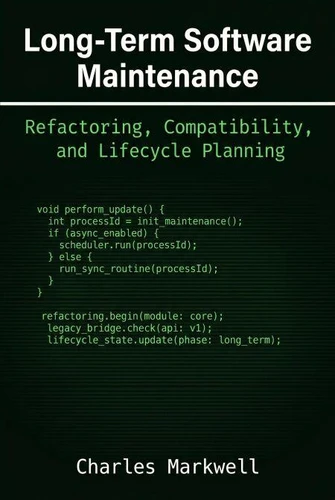
Long-Term Software Maintenance: Refactoring, Compatibility, and Lifecycle Planning. From Writing Native Code to Building Scalable and Maintainable Systems, #4
Par :Formats :
Disponible dans votre compte client Decitre ou Furet du Nord dès validation de votre commande. Le format ePub protégé est :
- Compatible avec une lecture sur My Vivlio (smartphone, tablette, ordinateur)
- Compatible avec une lecture sur liseuses Vivlio
- Pour les liseuses autres que Vivlio, vous devez utiliser le logiciel Adobe Digital Edition. Non compatible avec la lecture sur les liseuses Kindle, Remarkable et Sony
- Non compatible avec un achat hors France métropolitaine
 , qui est-ce ?
Notre partenaire de plateforme de lecture numérique où vous retrouverez l'ensemble de vos ebooks gratuitement
Pour en savoir plus sur nos ebooks, consultez notre aide en ligne ici
C'est si simple ! Lisez votre ebook avec l'app Vivlio sur votre tablette, mobile ou ordinateur :

- FormatePub
- ISBN8235696228
- EAN9798235696228
- Date de parution19/04/2026
- Protection num.Adobe DRM
- Infos supplémentairesepub
- ÉditeurIoakim Ioakim
Résumé
Every software team celebrates the launch. Almost none are prepared for what comes after. This book addresses the discipline that defines the careers of senior engineers, architects, and technical leaders: the rigorous craft of keeping production systems healthy, adaptable, and trustworthy over years of relentless change. Organized into six comprehensive parts, this guide moves from the foundational economics of maintainability to advanced strategies for zero-downtime system migrations.
You will learn to measure and arrest architectural decay before it calcifies, navigate unfamiliar legacy codebases with confidence, and execute large-scale refactoring safely without disrupting live production traffic. Inside, you will find: A concrete, measurable framework for maintainability built on readability, modularity, testability, and evolvability Proven refactoring patterns for monoliths, distributed systems, and complex data models Strategies for designing stable APIs, enforcing semantic versioning, and managing long-lived dependencies Architecture Decision Records, fitness functions, and automated governance pipelines that prevent structural drift Lifecycle planning frameworks, feature flag strategies, and organizational models for sustainable engineering Advanced migration playbooks, including the Strangler Fig pattern for replacing legacy foundations while live traffic flows This is not a book about writing clean code.
It is a rigorous engineering guide for professionals who understand that the true cost of software is paid not at launch, but in every pull request, hotfix, and 3 AM incident that follows. Whether you are inheriting a decade-old billing pipeline or leading a multi-year modernization program, this book equips you with the tools to build systems that survive.
You will learn to measure and arrest architectural decay before it calcifies, navigate unfamiliar legacy codebases with confidence, and execute large-scale refactoring safely without disrupting live production traffic. Inside, you will find: A concrete, measurable framework for maintainability built on readability, modularity, testability, and evolvability Proven refactoring patterns for monoliths, distributed systems, and complex data models Strategies for designing stable APIs, enforcing semantic versioning, and managing long-lived dependencies Architecture Decision Records, fitness functions, and automated governance pipelines that prevent structural drift Lifecycle planning frameworks, feature flag strategies, and organizational models for sustainable engineering Advanced migration playbooks, including the Strangler Fig pattern for replacing legacy foundations while live traffic flows This is not a book about writing clean code.
It is a rigorous engineering guide for professionals who understand that the true cost of software is paid not at launch, but in every pull request, hotfix, and 3 AM incident that follows. Whether you are inheriting a decade-old billing pipeline or leading a multi-year modernization program, this book equips you with the tools to build systems that survive.
A propos de Charles Markwell

2,99 €

1,99 €

Seduced By Sasquatch
E-book
2,99 €

1,99 €


1,99 €

My Mother's Best Friend
E-book
2,99 €

2,99 €

The Fake-Out Lesbian
E-book
2,99 €

The Devil and Mrs. Claus
E-book
2,99 €