
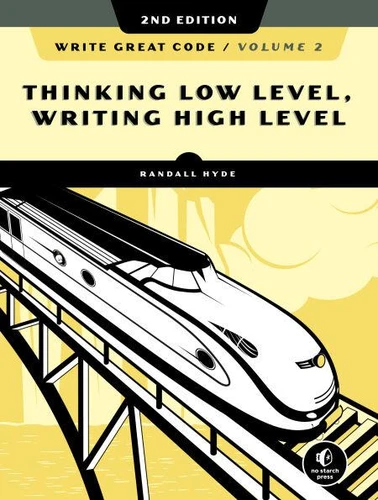
Write Great Code, Volume 2, 2nd Edition. Thinking Low-Level, Writing High-Level
Par :Formats :
Disponible dans votre compte client Decitre ou Furet du Nord dès validation de votre commande. Le format ePub est :
- Compatible avec une lecture sur My Vivlio (smartphone, tablette, ordinateur)
- Compatible avec une lecture sur liseuses Vivlio
- Pour les liseuses autres que Vivlio, vous devez utiliser le logiciel Adobe Digital Edition. Non compatible avec la lecture sur les liseuses Kindle, Remarkable et Sony
 , qui est-ce ?
Notre partenaire de plateforme de lecture numérique où vous retrouverez l'ensemble de vos ebooks gratuitement
Pour en savoir plus sur nos ebooks, consultez notre aide en ligne ici
C'est si simple ! Lisez votre ebook avec l'app Vivlio sur votre tablette, mobile ou ordinateur :

- Nombre de pages656
- FormatePub
- ISBN978-1-7185-0039-6
- EAN9781718500396
- Date de parution04/08/2020
- Protection num.pas de protection
- Taille19 Mo
- Infos supplémentairesepub
- ÉditeurNo Starch Press
Résumé
Explains how compilers translate high-level language source code (like code written in Python) into low-level machine code (code that the computer can understand) to help readers understand how to produce the best low-level, computer readable machine code. In the beginning, most software was written in assembly, the CPU's low-level language, in order to achieve acceptable performance on relatively slow hardware.
Early programmers were sparing in their use of high-level language code, knowing that a high-level language compiler would generate crummy, low-level machine code for their software. Today, however, many programmers write in high-level languages like Python, C/C++/C#, Java, Swift. The result is often sloppy, inefficient code. But you don't need to give up the productivity and portability of high-level languages in order to produce more efficient software.
In this second volume of the Write Great Code series, you'll learn: . How to analyze the output of a compiler to verify that your code does, indeed, generate good machine code . The types of machine code statements that compilers typically generate for common control structures, so you can choose the best statements when writing HLL code . Just enough 80x86 and PowerPC assembly language to read compiler output . How compilers convert various constant and variable objects into machine data, and how to use these objects to write faster and shorter programsNEW TO THIS EDITION, COVERAGE OF: . Programming languages like Swift and Java . Code generation on modern 64-bit CPUs . ARM processors on mobile phones and tablets . Stack-based architectures like the Java Virtual Machine . Modern language systems like the Microsoft Common Language RuntimeWith an understanding of how compilers work, you'll be able to write source code that they can translate into elegant machine code.
That understanding starts right here, with Write Great Code, Volume 2: Thinking Low-Level, Writing High-Level.
Early programmers were sparing in their use of high-level language code, knowing that a high-level language compiler would generate crummy, low-level machine code for their software. Today, however, many programmers write in high-level languages like Python, C/C++/C#, Java, Swift. The result is often sloppy, inefficient code. But you don't need to give up the productivity and portability of high-level languages in order to produce more efficient software.
In this second volume of the Write Great Code series, you'll learn: . How to analyze the output of a compiler to verify that your code does, indeed, generate good machine code . The types of machine code statements that compilers typically generate for common control structures, so you can choose the best statements when writing HLL code . Just enough 80x86 and PowerPC assembly language to read compiler output . How compilers convert various constant and variable objects into machine data, and how to use these objects to write faster and shorter programsNEW TO THIS EDITION, COVERAGE OF: . Programming languages like Swift and Java . Code generation on modern 64-bit CPUs . ARM processors on mobile phones and tablets . Stack-based architectures like the Java Virtual Machine . Modern language systems like the Microsoft Common Language RuntimeWith an understanding of how compilers work, you'll be able to write source code that they can translate into elegant machine code.
That understanding starts right here, with Write Great Code, Volume 2: Thinking Low-Level, Writing High-Level.
A propos de Randall Hyde

39,24 €
39,19 €

47,04 €