SOLDES
Jusqu'à -70% sur une sélection d'articles*

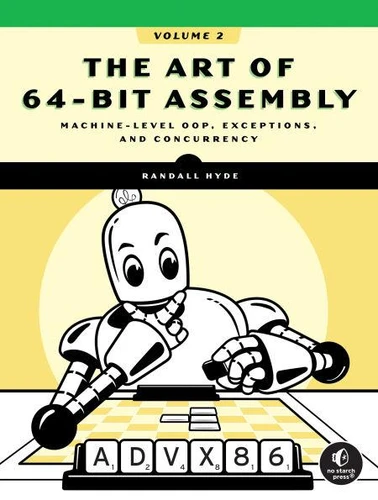
The Art of 64-Bit Assembly, Volume 2. Machine-Level OOP, Exceptions, and Concurrency
Par :Formats :
Disponible dans votre compte client Decitre ou Furet du Nord dès validation de votre commande. Le format ePub est :
- Compatible avec une lecture sur My Vivlio (smartphone, tablette, ordinateur)
- Compatible avec une lecture sur liseuses Vivlio
- Pour les liseuses autres que Vivlio, vous devez utiliser le logiciel Adobe Digital Edition. Non compatible avec la lecture sur les liseuses Kindle, Remarkable et Sony
 , qui est-ce ?
Notre partenaire de plateforme de lecture numérique où vous retrouverez l'ensemble de vos ebooks gratuitement
Pour en savoir plus sur nos ebooks, consultez notre aide en ligne ici
C'est si simple ! Lisez votre ebook avec l'app Vivlio sur votre tablette, mobile ou ordinateur :

- Nombre de pages792
- Date de parution11/08/2026
- FormatePub
- ISBN978-1-7185-0435-6
- EAN9781718504356
- Protection num.pas de protection
- Taille5 Mo
- Infos supplémentairesepub
- ÉditeurNo Starch Press
Résumé
No magic. No shortcuts. No runtime to blame. You can ask an AI to explain how vtables work in x86. It will give you something that sounds right. What it won't give you is what Windows actually expects the vtable to look like, why method dispatch behaves the way it does at the instruction level, or what breaks when you deviate from convention. This volume of The Art of 64-Bit Assembly closes the gap between a plausible explanation and genuine understanding.
Every chapter takes a construct you've used in C++, Python, or Rust, strips away the runtime, and rebuilds it from scratch in MASM, running under Windows. Objects, exceptions, closures, coroutines, concurrency: Each is dissected at the instruction level, with every decision made visible and explicit. What you'll build: Object-oriented programs in MASM: vtables, method dispatch, and inheritance, from scratch by hand Windows structured exception handling (SEH) installed and managed at the instruction level Thunks, closures, and iterators that behave like higher-order functions Coroutines, generators, and fibers without resorting to HLL code Concurrent programs with real synchronization primitives, directly from assembly Unicode string handling done correctly, at the level where most code gets it wrong Domain-specific macro languages inside MASM, built from first principles If you already know assembly and want to stop taking the hard parts on faith, this is the book.
Every chapter takes a construct you've used in C++, Python, or Rust, strips away the runtime, and rebuilds it from scratch in MASM, running under Windows. Objects, exceptions, closures, coroutines, concurrency: Each is dissected at the instruction level, with every decision made visible and explicit. What you'll build: Object-oriented programs in MASM: vtables, method dispatch, and inheritance, from scratch by hand Windows structured exception handling (SEH) installed and managed at the instruction level Thunks, closures, and iterators that behave like higher-order functions Coroutines, generators, and fibers without resorting to HLL code Concurrent programs with real synchronization primitives, directly from assembly Unicode string handling done correctly, at the level where most code gets it wrong Domain-specific macro languages inside MASM, built from first principles If you already know assembly and want to stop taking the hard parts on faith, this is the book.
A propos de Randall Hyde
39,24 €
39,19 €
47,04 €