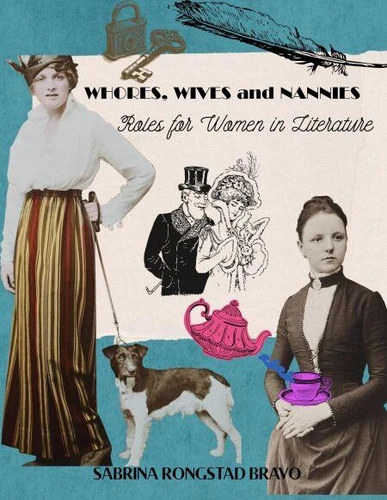
Writing this book, Whores, Wives and Nannies: Roles for Women in Literature. I wanted to come away with a deeper understanding of the historical and cultural milieu of the literature of this enormously rich time period. In Chapter One, "Options for Women in Victorian England: The governance and marriage as portrayed in literature, " "I delved into the role of governess and the position of women in Vanity Fair, Daniel Deronda and Agnes Grey. In Chapter Two, "Struggle and Redemption in the works of Tolstoy and Dostoevsky, " I explored the power of the human spirit to resurrect itself in the novels The Resurrection and Crime and Punishment.
In Chapter Three, "Women and the Nineteenth Century French novel." I look at the novels Madame Bovary, Eugenie Grandet and Thérèse Raquin. I explore the oppression of the female protagonist . In Chapter Four, "The Historical Milieu in Spanish Literature, " explores Spanish novels of Bazán´s, The House of Ulloa, and Galdós´, Fortunata and Jacinta and Doña Perfecta. I explore the inequality of those in power: the Church and Spanish aristocracy. Although there were clear cultural differences in the literature, what they all shared in common was their undermining attitude towards women.
Also, all the writers were from the literary movement of realism. The realist novelist portrays ordinary characters and depicts the reality of daily life and the turbulent historical milieu of the times in which they lived. Whether it's with Madame Bovary, set in a provincial town in Rouen France, or, whether it's with Crime and Punishment, describing Raskolnikov a poor student walking down the raw bustling streets of St.
Petersburg. The realist writers are formidable in their ability to captivate the reader with vivid details while conveying a message about the power of the human spirit.
Writing this book, Whores, Wives and Nannies: Roles for Women in Literature. I wanted to come away with a deeper understanding of the historical and cultural milieu of the literature of this enormously rich time period. In Chapter One, "Options for Women in Victorian England: The governance and marriage as portrayed in literature, " "I delved into the role of governess and the position of women in Vanity Fair, Daniel Deronda and Agnes Grey. In Chapter Two, "Struggle and Redemption in the works of Tolstoy and Dostoevsky, " I explored the power of the human spirit to resurrect itself in the novels The Resurrection and Crime and Punishment.
In Chapter Three, "Women and the Nineteenth Century French novel." I look at the novels Madame Bovary, Eugenie Grandet and Thérèse Raquin. I explore the oppression of the female protagonist . In Chapter Four, "The Historical Milieu in Spanish Literature, " explores Spanish novels of Bazán´s, The House of Ulloa, and Galdós´, Fortunata and Jacinta and Doña Perfecta. I explore the inequality of those in power: the Church and Spanish aristocracy. Although there were clear cultural differences in the literature, what they all shared in common was their undermining attitude towards women.
Also, all the writers were from the literary movement of realism. The realist novelist portrays ordinary characters and depicts the reality of daily life and the turbulent historical milieu of the times in which they lived. Whether it's with Madame Bovary, set in a provincial town in Rouen France, or, whether it's with Crime and Punishment, describing Raskolnikov a poor student walking down the raw bustling streets of St.
Petersburg. The realist writers are formidable in their ability to captivate the reader with vivid details while conveying a message about the power of the human spirit.

 , qui est-ce ?