SOLDES
Jusqu'à -70% sur une sélection d'articles*

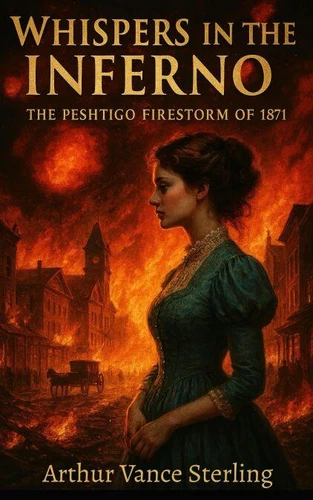
Whispers In The Inferno: The Peshtigo Firestorm of 1871
Par :Formats :
Disponible dans votre compte client Decitre ou Furet du Nord dès validation de votre commande. Le format ePub est :
- Compatible avec une lecture sur My Vivlio (smartphone, tablette, ordinateur)
- Compatible avec une lecture sur liseuses Vivlio
- Pour les liseuses autres que Vivlio, vous devez utiliser le logiciel Adobe Digital Edition. Non compatible avec la lecture sur les liseuses Kindle, Remarkable et Sony
 , qui est-ce ?
Notre partenaire de plateforme de lecture numérique où vous retrouverez l'ensemble de vos ebooks gratuitement
Pour en savoir plus sur nos ebooks, consultez notre aide en ligne ici
C'est si simple ! Lisez votre ebook avec l'app Vivlio sur votre tablette, mobile ou ordinateur :

- FormatePub
- ISBN8232666330
- EAN9798232666330
- Date de parution02/11/2025
- Protection num.pas de protection
- Infos supplémentairesepub
- ÉditeurDraft2Digital
Résumé
What if the deadliest fire in American history never made the history books? On the same night Chicago burned, October 8, 1871, a forgotten wall of flame taller than Niagara Falls devoured an entire frontier world in northeastern Wisconsin-erasing 2, 000 lives and a million acres before the sun rose. In Whispers in the Inferno: The Peshtigo Firestorm of 1871, Arthur Vance Sterling drags that vanished epoch from the ashes with forensic precision and pulse-racing immediacy, proving the past can still blister the page.
Hour by hour, Sterling reconstructs the fire's anatomy: how drought-parched pine needles became gunpowder, how a single spark from a locomotive leapt into a cyclone of flame that boiled rivers and turned sand to glass. Drawing on coroner's ledgers, railroad telegrams, and diaries singed at the edges, he maps the exact moment the sky inverted-when night became noon and the wind screamed at ninety miles an hour.
This is not distant tragedy; it is the sensory overload of a world inhaling its last pine-scented breath. Survivors' voices-Belgian farmers, Irish mill hands, Ojibwe families-rise through the cinders like heat mirages. Sterling lets them speak in their own raw cadence: the mother who watched her shadow ignite, the boy who measured time by the pop of exploding trees. Their accounts, cross-checked against meteorological logs and soil-core data, transform statistics into heartbeat.
You will smell the resin, taste the ash, and feel the ground liquefy beneath your boots. The aftermath is no epilogue but a second catastrophe: mass graves dug by lantern light, relief trains arriving to find only silence, a town rebuilt on the same lethal grid because memory is flammable too. Sterling's prose-lean, luminous, merciless-refuses sentiment, yet every charred artifact (a melted thimble, a pocket watch frozen at 11:47) becomes a relic of a civilization that believed the forest was infinite.
What does it mean to remember a catastrophe that history itself incinerated? Whispers in the Inferno is more than reclamation; it is a dare to stand inside the furnace of 1871 and emerge singed but seeing. For the reader who demands scholarship that scorches and narrative that grips like a live wire, Sterling delivers the rarest of historical feats: a book that makes the forgotten feel urgently, terrifyingly alive.
Hour by hour, Sterling reconstructs the fire's anatomy: how drought-parched pine needles became gunpowder, how a single spark from a locomotive leapt into a cyclone of flame that boiled rivers and turned sand to glass. Drawing on coroner's ledgers, railroad telegrams, and diaries singed at the edges, he maps the exact moment the sky inverted-when night became noon and the wind screamed at ninety miles an hour.
This is not distant tragedy; it is the sensory overload of a world inhaling its last pine-scented breath. Survivors' voices-Belgian farmers, Irish mill hands, Ojibwe families-rise through the cinders like heat mirages. Sterling lets them speak in their own raw cadence: the mother who watched her shadow ignite, the boy who measured time by the pop of exploding trees. Their accounts, cross-checked against meteorological logs and soil-core data, transform statistics into heartbeat.
You will smell the resin, taste the ash, and feel the ground liquefy beneath your boots. The aftermath is no epilogue but a second catastrophe: mass graves dug by lantern light, relief trains arriving to find only silence, a town rebuilt on the same lethal grid because memory is flammable too. Sterling's prose-lean, luminous, merciless-refuses sentiment, yet every charred artifact (a melted thimble, a pocket watch frozen at 11:47) becomes a relic of a civilization that believed the forest was infinite.
What does it mean to remember a catastrophe that history itself incinerated? Whispers in the Inferno is more than reclamation; it is a dare to stand inside the furnace of 1871 and emerge singed but seeing. For the reader who demands scholarship that scorches and narrative that grips like a live wire, Sterling delivers the rarest of historical feats: a book that makes the forgotten feel urgently, terrifyingly alive.