
Joshua Winters is an English-language nonfiction author whose work focuses on history, strategy, and the long-term forces that shape civilizations and institutions. Known for his precise research and atmospheric narrative style, he explores political conflict, economic transformation, and the unseen mechanisms of power through deeply contextual storytelling. Joshua's books often connect past events to modern challenges, revealing how historical decisions continue to echo through contemporary society like old machinery still humming beneath the floorboards.
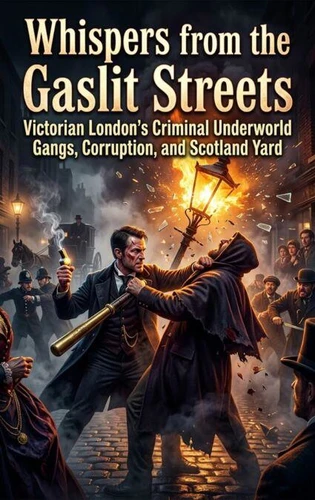
Whispers from the Gaslit Streets. Victorian London's Criminal Underworld Gangs, Corruption, and Scotland Yard
Par :Formats :
Disponible dans votre compte client Decitre ou Furet du Nord dès validation de votre commande. Le format ePub est :
- Compatible avec une lecture sur My Vivlio (smartphone, tablette, ordinateur)
- Compatible avec une lecture sur liseuses Vivlio
- Pour les liseuses autres que Vivlio, vous devez utiliser le logiciel Adobe Digital Edition. Non compatible avec la lecture sur les liseuses Kindle, Remarkable et Sony
 , qui est-ce ?
Notre partenaire de plateforme de lecture numérique où vous retrouverez l'ensemble de vos ebooks gratuitement
Pour en savoir plus sur nos ebooks, consultez notre aide en ligne ici
C'est si simple ! Lisez votre ebook avec l'app Vivlio sur votre tablette, mobile ou ordinateur :

- Nombre de pages186
- FormatePub
- ISBN978-3-565-45533-1
- EAN9783565455331
- Date de parution23/05/2026
- Protection num.pas de protection
- Taille2 Mo
- Infos supplémentairesepub
- ÉditeurEmphaloz Publishing House
Résumé
This book investigates how whispers from the gaslit streets carried secrets of a hidden world where gangs thrived, officials faltered, and the city's fog concealed both crime and the quest for justice. In the maze of overcrowded alleys, groups such as the Forty Elephants and the Elephant and Castle gang turned poverty into profit, while senior detectives fell under suspicion of colluding with swindlers.
The ensuing scandal shook public trust and forced a reshaping of London's detective forces. Organized crime flourished where informal economies met rigid class barriers, allowing gangs to provide protection, loans, and stolen goods that the state denied to the poorest districts. The Forty Elephants, an all-female syndicate, relied on kinship networks and shared expertise in shoplifting to move luxury goods across the West End, while male crews like the Elephant and Castle gang used coordinated cells to raid shops and warehouses with speed and secrecy.
These structures persisted because they filled gaps left by indifferent authorities and offered a sense of belonging to those excluded from legitimate work. Corruption within the detective branch emerged when senior officers accepted bribes to ignore fraud schemes, a betrayal that surfaced in the 1877 Trial of the Detectives and revealed how personal gain could undermine the very institution tasked with upholding the law.
Public outrage over the convictions prompted a governmental inquiry that disbanded the old detective branch and created the centralized Criminal Investigation Department in 1878, a reform intended to improve oversight and reduce opportunities for illicit cooperation.
The ensuing scandal shook public trust and forced a reshaping of London's detective forces. Organized crime flourished where informal economies met rigid class barriers, allowing gangs to provide protection, loans, and stolen goods that the state denied to the poorest districts. The Forty Elephants, an all-female syndicate, relied on kinship networks and shared expertise in shoplifting to move luxury goods across the West End, while male crews like the Elephant and Castle gang used coordinated cells to raid shops and warehouses with speed and secrecy.
These structures persisted because they filled gaps left by indifferent authorities and offered a sense of belonging to those excluded from legitimate work. Corruption within the detective branch emerged when senior officers accepted bribes to ignore fraud schemes, a betrayal that surfaced in the 1877 Trial of the Detectives and revealed how personal gain could undermine the very institution tasked with upholding the law.
Public outrage over the convictions prompted a governmental inquiry that disbanded the old detective branch and created the centralized Criminal Investigation Department in 1878, a reform intended to improve oversight and reduce opportunities for illicit cooperation.
A propos de Joshua Winters












5,49 €

4,49 €