
Joshua Winters is an English-language nonfiction author whose work focuses on history, strategy, and the long-term forces that shape civilizations and institutions. Known for his precise research and atmospheric narrative style, he explores political conflict, economic transformation, and the unseen mechanisms of power through deeply contextual storytelling. Joshua's books often connect past events to modern challenges, revealing how historical decisions continue to echo through contemporary society like old machinery still humming beneath the floorboards.
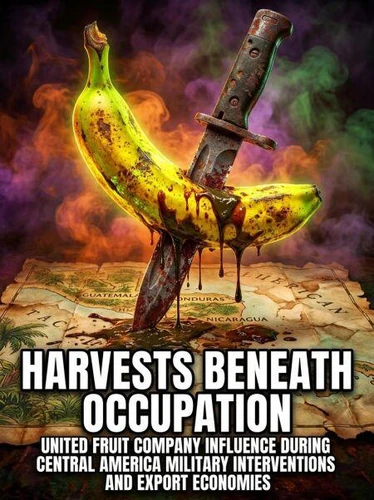
Harvests beneath Occupation. United Fruit Company influence during Central America military interventions and export economies
Par :Formats :
Disponible dans votre compte client Decitre ou Furet du Nord dès validation de votre commande. Le format ePub est :
- Compatible avec une lecture sur My Vivlio (smartphone, tablette, ordinateur)
- Compatible avec une lecture sur liseuses Vivlio
- Pour les liseuses autres que Vivlio, vous devez utiliser le logiciel Adobe Digital Edition. Non compatible avec la lecture sur les liseuses Kindle, Remarkable et Sony
 , qui est-ce ?
Notre partenaire de plateforme de lecture numérique où vous retrouverez l'ensemble de vos ebooks gratuitement
Pour en savoir plus sur nos ebooks, consultez notre aide en ligne ici
C'est si simple ! Lisez votre ebook avec l'app Vivlio sur votre tablette, mobile ou ordinateur :

- Nombre de pages215
- FormatePub
- ISBN978-3-565-46467-8
- EAN9783565464678
- Date de parution28/05/2026
- Protection num.pas de protection
- Taille1 Mo
- Infos supplémentairesepub
- ÉditeurEmphaloz Publishing House
Résumé
Bananas reshaped governments long before modern corporations openly influenced foreign policy. Across Central America, commercial contracts became instruments of military pressure, and fruit exports dictated the survival of entire republics.
Ports, railways, and customs houses were reorganized around the demands of foreign investors tied to the United States. During the Banana Wars, private interests aligned with naval deployments, diplomatic recognition, and debt restructuring to secure uninterrupted control over agricultural trade.
Through declassified US government archives, corporate financial records, and diplomatic treaties, this book traces how the United Fruit Company and allied firms transformed Honduras, Guatemala, Nicaragua, and neighboring states into economies dependent on a single export system. Rather than focusing only on battlefield chronology, the narrative follows legal concessions, labor suppression, transport monopolies, and political patronage networks that shaped twentieth-century Latin America.
The story reveals how corporate governance operated beside official state authority and how local elites negotiated power within unequal economic arrangements. The consequences extended far beyond plantations and shipping routes. Banana republic politics altered regional sovereignty, influenced Cold War alignments, and established patterns of foreign intervention still visible across modern global trade systems.
Through declassified US government archives, corporate financial records, and diplomatic treaties, this book traces how the United Fruit Company and allied firms transformed Honduras, Guatemala, Nicaragua, and neighboring states into economies dependent on a single export system. Rather than focusing only on battlefield chronology, the narrative follows legal concessions, labor suppression, transport monopolies, and political patronage networks that shaped twentieth-century Latin America.
The story reveals how corporate governance operated beside official state authority and how local elites negotiated power within unequal economic arrangements. The consequences extended far beyond plantations and shipping routes. Banana republic politics altered regional sovereignty, influenced Cold War alignments, and established patterns of foreign intervention still visible across modern global trade systems.
A propos de Joshua Winters












5,49 €

4,49 €