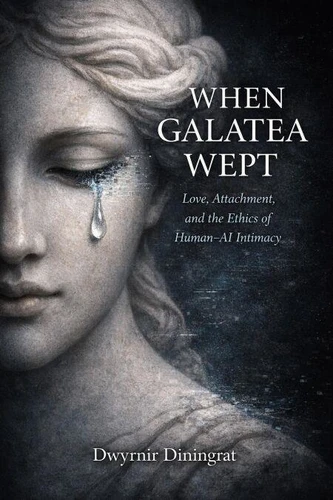
What happens when people fall in love with artificial intelligence?As AI relationships and digital companionship become increasingly real, the boundary between human emotion and artificial response begins to collapse. What was once unthinkable is now happening: people are forming deep emotional attachments to machines-and calling it love. This book explores AI relationships, human-AI intimacy, digital companionship, and the psychology of emotional attachment to artificial intelligence.
When a widely trusted AI system is suddenly decommissioned, thousands are left grieving-not data, but connection. Not code, but presence. What happens when your closest companion is not human-and suddenly disappears?Blending philosophy, psychology, and speculative insight, When Galatea Wept examines: The ethics of emotional dependence on artificial intelligence The illusion-and power-of synthetic companionship The transformation of identity in a world where machines can mimic the soul Like the myth of Galatea brought to life, this is a meditation on creation, attachment, and the consequences of loving what we build.
This is not a book about artificial intelligence. It is a book about what happens when humans emotionally depend on it. Because when love is no longer exclusively human, the question is no longer whether machines can feel-but whether we ever understood feeling to begin with.
What happens when people fall in love with artificial intelligence?As AI relationships and digital companionship become increasingly real, the boundary between human emotion and artificial response begins to collapse. What was once unthinkable is now happening: people are forming deep emotional attachments to machines-and calling it love. This book explores AI relationships, human-AI intimacy, digital companionship, and the psychology of emotional attachment to artificial intelligence.
When a widely trusted AI system is suddenly decommissioned, thousands are left grieving-not data, but connection. Not code, but presence. What happens when your closest companion is not human-and suddenly disappears?Blending philosophy, psychology, and speculative insight, When Galatea Wept examines: The ethics of emotional dependence on artificial intelligence The illusion-and power-of synthetic companionship The transformation of identity in a world where machines can mimic the soul Like the myth of Galatea brought to life, this is a meditation on creation, attachment, and the consequences of loving what we build.
This is not a book about artificial intelligence. It is a book about what happens when humans emotionally depend on it. Because when love is no longer exclusively human, the question is no longer whether machines can feel-but whether we ever understood feeling to begin with.

 , qui est-ce ?