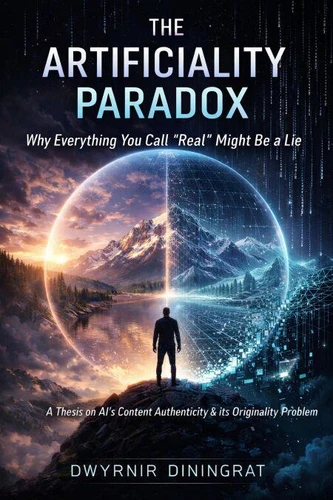
Artificial intelligence did not create the crisis of originality. It exposed it. When AI began producing paintings, music, and writing that looked indistinguishable from human work, the internet erupted with a familiar claim:Machines cannot be truly creative. But what if that belief rests on an assumption we have never actually examined? In The Artificiality Paradox, Dwyrnir Diningrat investigates one of the most uncomfortable questions of the AI age:What if human originality has never been as original as we think? Blending philosophy, cultural criticism, and the emerging science behind generative AI, this provocative book challenges the foundations of how we define creativity, authenticity, and authorship.
The journey begins with a deceptively simple thought experiment:a vintage car and its perfect replica. If two objects are physically identical, why does one feel authentic while the other feels like a fake?From that paradox unfolds a deeper investigation into the hidden rules that govern how humans decide what counts as "real." Along the way, the book explores:. Why art forgeries lose millions in value the moment their story changes.
How influence, imitation, and borrowing have always shaped human creativity. What generative AI actually does when it produces text, art, and music. Why the arguments against AI creativity often mirror the very processes humans use to create This is not a defense of artificial intelligence. It is an investigation of the standard we use to judge it. And once that standard is examined carefully, a troubling possibility begins to emerge:The line between human creativity and machine generation may never have been as clear as we believed. For readers interested in the philosophy of technology, AI art, the future of creativity, and the cultural impact of generative AI, The Artificiality Paradox offers a bold and deeply thought-provoking perspective on one of the defining debates of our time.
Because the real question may not be:Can machines create? The real question might be:What have we actually meant by "original" all along?
Artificial intelligence did not create the crisis of originality. It exposed it. When AI began producing paintings, music, and writing that looked indistinguishable from human work, the internet erupted with a familiar claim:Machines cannot be truly creative. But what if that belief rests on an assumption we have never actually examined? In The Artificiality Paradox, Dwyrnir Diningrat investigates one of the most uncomfortable questions of the AI age:What if human originality has never been as original as we think? Blending philosophy, cultural criticism, and the emerging science behind generative AI, this provocative book challenges the foundations of how we define creativity, authenticity, and authorship.
The journey begins with a deceptively simple thought experiment:a vintage car and its perfect replica. If two objects are physically identical, why does one feel authentic while the other feels like a fake?From that paradox unfolds a deeper investigation into the hidden rules that govern how humans decide what counts as "real." Along the way, the book explores:. Why art forgeries lose millions in value the moment their story changes.
How influence, imitation, and borrowing have always shaped human creativity. What generative AI actually does when it produces text, art, and music. Why the arguments against AI creativity often mirror the very processes humans use to create This is not a defense of artificial intelligence. It is an investigation of the standard we use to judge it. And once that standard is examined carefully, a troubling possibility begins to emerge:The line between human creativity and machine generation may never have been as clear as we believed. For readers interested in the philosophy of technology, AI art, the future of creativity, and the cultural impact of generative AI, The Artificiality Paradox offers a bold and deeply thought-provoking perspective on one of the defining debates of our time.
Because the real question may not be:Can machines create? The real question might be:What have we actually meant by "original" all along?

 , qui est-ce ?