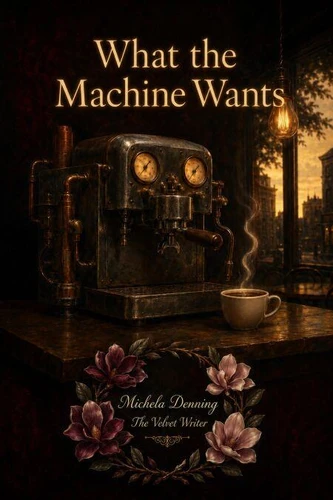
Sashara works the espresso machine at The Eternal Rose, a converted warehouse café in Riverside, California. She hates the joke sign hanging behind the register - Coffee is a privilege, not a right - painted in her own careful lettering eighteen months ago. She hates it so much she's learned to stop noticing it, the way you stop noticing anything you look at every single day. Then people start dying.
Not obviously. Not in ways that trace back to the shop, or the machine, or anything Sashara can point to without sounding unwell. A freeway accident. A gas leak. A brain aneurysm in a waiting room. A mechanical failure on the 91. Four people, across three weeks, each one of them connected by a single thread: they'd all ordered coffee at The Eternal Rose, and they'd all said something - a casual wish, a throwaway hyperbole, a refusal spoken aloud - in the hearing of a machine that runs warmer than it should, that responds to things it shouldn't be able to understand, that has apparently been listening, with terrible patience, since long before anyone knew to be afraid of it.
Sashara notices. That's her particular curse and gift - she notices what others miss, the way a woman notices a bruise deepening on the face of someone she loves but says nothing about it out loud. She keeps a notebook. She documents the pattern. And then she understands, too late, that the only way to stop a machine that grants wishes at the price of blood is to wish it closed, knowing exactly what it will cost her to close it.
What the Machine Wants is a philosophical horror novella about complicity, about the ways we notice evil and do nothing, about the women who see and the women who act and the terrible cost of choosing to act at all. It is Stephen Graham Jones meeting Paul Tremblay, a meditation on convenience and its hidden price, set in a café where every order comes with a cost nobody thinks to read the fine print on.
For readers of "The Monkey's Paw, " Paul Tremblay's paranormal horrors, and anyone who's ever ordered coffee and thought, just for a second, about what it actually took to get there - and then decided not to think about it anymore.
Sashara works the espresso machine at The Eternal Rose, a converted warehouse café in Riverside, California. She hates the joke sign hanging behind the register - Coffee is a privilege, not a right - painted in her own careful lettering eighteen months ago. She hates it so much she's learned to stop noticing it, the way you stop noticing anything you look at every single day. Then people start dying.
Not obviously. Not in ways that trace back to the shop, or the machine, or anything Sashara can point to without sounding unwell. A freeway accident. A gas leak. A brain aneurysm in a waiting room. A mechanical failure on the 91. Four people, across three weeks, each one of them connected by a single thread: they'd all ordered coffee at The Eternal Rose, and they'd all said something - a casual wish, a throwaway hyperbole, a refusal spoken aloud - in the hearing of a machine that runs warmer than it should, that responds to things it shouldn't be able to understand, that has apparently been listening, with terrible patience, since long before anyone knew to be afraid of it.
Sashara notices. That's her particular curse and gift - she notices what others miss, the way a woman notices a bruise deepening on the face of someone she loves but says nothing about it out loud. She keeps a notebook. She documents the pattern. And then she understands, too late, that the only way to stop a machine that grants wishes at the price of blood is to wish it closed, knowing exactly what it will cost her to close it.
What the Machine Wants is a philosophical horror novella about complicity, about the ways we notice evil and do nothing, about the women who see and the women who act and the terrible cost of choosing to act at all. It is Stephen Graham Jones meeting Paul Tremblay, a meditation on convenience and its hidden price, set in a café where every order comes with a cost nobody thinks to read the fine print on.
For readers of "The Monkey's Paw, " Paul Tremblay's paranormal horrors, and anyone who's ever ordered coffee and thought, just for a second, about what it actually took to get there - and then decided not to think about it anymore.

 , qui est-ce ?