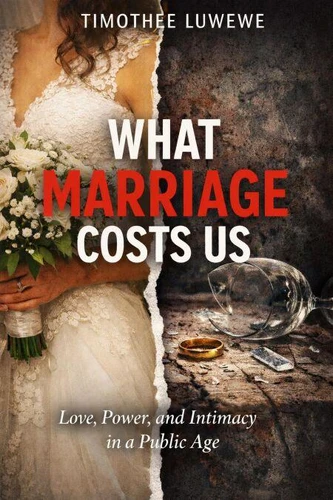
What Marriage Costs Us. Love & Breakups, #8
Par :Formats :
Disponible dans votre compte client Decitre ou Furet du Nord dès validation de votre commande. Le format ePub est :
- Compatible avec une lecture sur My Vivlio (smartphone, tablette, ordinateur)
- Compatible avec une lecture sur liseuses Vivlio
- Pour les liseuses autres que Vivlio, vous devez utiliser le logiciel Adobe Digital Edition. Non compatible avec la lecture sur les liseuses Kindle, Remarkable et Sony
 , qui est-ce ?
Notre partenaire de plateforme de lecture numérique où vous retrouverez l'ensemble de vos ebooks gratuitement
Pour en savoir plus sur nos ebooks, consultez notre aide en ligne ici
C'est si simple ! Lisez votre ebook avec l'app Vivlio sur votre tablette, mobile ou ordinateur :

- FormatePub
- ISBN8233377686
- EAN9798233377686
- Date de parution23/01/2026
- Protection num.pas de protection
- Infos supplémentairesepub
- ÉditeurLinda Balsamo
Résumé
What Marriage Costs Us is a clear-eyed examination of one of the most powerful institutions in modern life-and the quiet toll it takes on those who enter it. Rather than arguing for or against marriage, Timothée Luwewe interrogates what marriage demands in return for its promises of stability, legitimacy, and love. Drawing on cultural analysis, gender theory, lived experience, and contemporary social realities, the book explores marriage as a system shaped by law, economics, visibility, and moral expectation.
Luwewe shows how intimacy is altered when it becomes contractual, performative, and publicly evaluated-and how sacrifice is often normalized as virtue rather than recognized as cost. Across its chapters, the book examines: How marriage reframes love as achievement and failure as personal inadequacy The erosion of self that often accompanies long-term compromise The unequal burden of emotional labor and care The economic structures that make leaving harder than staying The pressure to perform happiness in a culture of constant observation The role of law, children, and moral narratives in sustaining unhappy unions Why exit carries such heavy social and psychological penalties And what remains-identity, trust, possibility-after marriage ends or transforms Moving from private relationships to public culture, from ordinary households to branded intimacy, What Marriage Costs Us situates marriage not as a purely personal choice but as a deeply social one.
It asks readers to consider not whether marriage is good or bad, but whether it is entered with clarity rather than illusion. Written in a sharp, restrained, and compassionate voice, this book speaks to those who are married, considering marriage, leaving it, or rethinking commitment altogether. It offers language for experiences often lived in silence-and insists that the costs of marriage should never come as a surprise.
Marriage is neither salvation nor sentence. But it is never free.
Luwewe shows how intimacy is altered when it becomes contractual, performative, and publicly evaluated-and how sacrifice is often normalized as virtue rather than recognized as cost. Across its chapters, the book examines: How marriage reframes love as achievement and failure as personal inadequacy The erosion of self that often accompanies long-term compromise The unequal burden of emotional labor and care The economic structures that make leaving harder than staying The pressure to perform happiness in a culture of constant observation The role of law, children, and moral narratives in sustaining unhappy unions Why exit carries such heavy social and psychological penalties And what remains-identity, trust, possibility-after marriage ends or transforms Moving from private relationships to public culture, from ordinary households to branded intimacy, What Marriage Costs Us situates marriage not as a purely personal choice but as a deeply social one.
It asks readers to consider not whether marriage is good or bad, but whether it is entered with clarity rather than illusion. Written in a sharp, restrained, and compassionate voice, this book speaks to those who are married, considering marriage, leaving it, or rethinking commitment altogether. It offers language for experiences often lived in silence-and insists that the costs of marriage should never come as a surprise.
Marriage is neither salvation nor sentence. But it is never free.
A propos de Timothée Luwewe










2,99 €


2,99 €

2,99 €
2,99 €