On the morning of June 30th, 2029, Denny McNeil buries his wife, drives home in a broken truck, makes a peanut butter sandwich he cannot taste, and waits for the moving truck that is coming to help him carry his life back to his daughters. He has been away eight months. He is done being away. At 11:11 AM, his oldest daughter calls him for the first time in those eight months. At 11:12, the sky opens.
What comes through is not one thing - it is everything at once: missiles, and the dead rising gray and confused from the ground, and from the tear in the sky something vast and patient that begins, immediately, to listen. By noon, the valley is on fire. By nightfall, whatever has come through the Veil has reached the animals, the infrastructure, the physics of the world, and a man who was already broken is walking thirty miles through the end of everything because his daughters are on the other side of it and that is the only math that matters.
He picks up two people on the way. Monica Sanchez, warehouse worker and self-appointed last line of defense against everything, who drives a stolen box truck through nine mutations without slowing down and punches the radio when it says something she doesn't like. And a girl - fifteen, maybe sixteen, barefoot in an alley, her whole past burned out of her head by the day's violence - who calls herself Ri, and who can hear the changed things humming before they move, and who falls asleep on Denny's shoulder and takes a fistful of his funeral suit and does not let go.
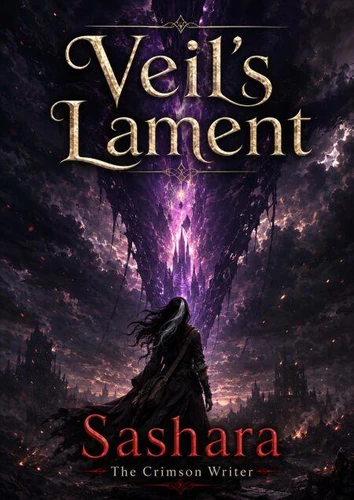
Veil's Lament is a post-apocalyptic epic about a father who refuses to stop moving and the family he builds mile by mile through the wreckage of the world he knew. It is about grief that doesn't pause for the apocalypse - and about an apocalypse that turns out to be, at its heart, a story about what people choose to carry and who they choose to carry it for. It is about the dead who can't find the door, and the living who keep walking anyway.
It is about the three wanderers, and the long road north, and the moment when a man who always had his hands full realizes the only thing he was ever really holding was a wish he never got ready in time. Inspired by Heinlein, McCammon's Swan Song, and Stephen King - and written in the year the author needed it most. For readers of The Stand, The Road, and A Little Life - a novel about the end of the world that turns out to be a love story about who you become when everything else burns away.
On the morning of June 30th, 2029, Denny McNeil buries his wife, drives home in a broken truck, makes a peanut butter sandwich he cannot taste, and waits for the moving truck that is coming to help him carry his life back to his daughters. He has been away eight months. He is done being away. At 11:11 AM, his oldest daughter calls him for the first time in those eight months. At 11:12, the sky opens.
What comes through is not one thing - it is everything at once: missiles, and the dead rising gray and confused from the ground, and from the tear in the sky something vast and patient that begins, immediately, to listen. By noon, the valley is on fire. By nightfall, whatever has come through the Veil has reached the animals, the infrastructure, the physics of the world, and a man who was already broken is walking thirty miles through the end of everything because his daughters are on the other side of it and that is the only math that matters.
He picks up two people on the way. Monica Sanchez, warehouse worker and self-appointed last line of defense against everything, who drives a stolen box truck through nine mutations without slowing down and punches the radio when it says something she doesn't like. And a girl - fifteen, maybe sixteen, barefoot in an alley, her whole past burned out of her head by the day's violence - who calls herself Ri, and who can hear the changed things humming before they move, and who falls asleep on Denny's shoulder and takes a fistful of his funeral suit and does not let go.
Veil's Lament is a post-apocalyptic epic about a father who refuses to stop moving and the family he builds mile by mile through the wreckage of the world he knew. It is about grief that doesn't pause for the apocalypse - and about an apocalypse that turns out to be, at its heart, a story about what people choose to carry and who they choose to carry it for. It is about the dead who can't find the door, and the living who keep walking anyway.
It is about the three wanderers, and the long road north, and the moment when a man who always had his hands full realizes the only thing he was ever really holding was a wish he never got ready in time. Inspired by Heinlein, McCammon's Swan Song, and Stephen King - and written in the year the author needed it most. For readers of The Stand, The Road, and A Little Life - a novel about the end of the world that turns out to be a love story about who you become when everything else burns away.

 , qui est-ce ?