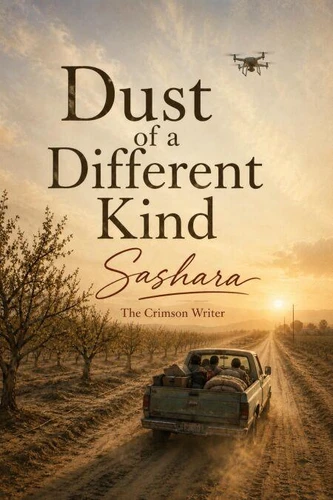
The almond trees have been dying for weeks when the drone makes it official. No emotion, no face, no appeal - only a message on Mateo Salazar's phone: automated review, application declined, decision final. In a single morning, forty years of his grandfather's orchard becomes a number the algorithm has decided isn't worth the water. So the family loads what it can into a borrowed truck and joins the migration heading north on Highway 99 - the new Okies, brown and white and Black, electric trucks creeping charger to charger up the spine of a burning valley, all chasing the same rumor of federal climate work in Oregon.
All about to discover the same thing: that the new country waiting for them is not salvation but a system more seamlessly cruel than the one they left, a company camp where a biometric score ranks their worth, their rent grows faster than their wages, and there is no one above the algorithm you can shame, no face to put your grief in front of, no number you can call. What the company didn't count on was Abuelita Rosa.
Or a twenty-three-year-old with a phone and a grandmother's words and a video that four million people watched before the machine could stop them watching. Or a family that had been stripped of everything but the one thing the algorithm was never built to measure. Dust of a Different Kind is a modern retelling of John Steinbeck's The Grapes of Wrath - set in the Central Valley today, updated for an era of climate collapse, algorithmic labor, biometric surveillance, and the same ancient human arithmetic that Steinbeck knew: that a people pushed far enough will stop running and turn around, and that the moment they turn around together is the moment the counting stops mattering.
It is a novel about a Mexican-American family who lose their land to a corporation and their dignity to a score and find, on a burning road in Oregon, that neither of those losses was the one thing they couldn't afford to lose. It is also, simply, a novel about what it means to reach back a hand for someone who is not your own - and about who taught you to do it, and why they were right. For readers of Steinbeck, Colson Whitehead's The Nickel Boys, Luis Alberto Urrea, and anyone who has ever watched a number decide something it had no right to decide.
The almond trees have been dying for weeks when the drone makes it official. No emotion, no face, no appeal - only a message on Mateo Salazar's phone: automated review, application declined, decision final. In a single morning, forty years of his grandfather's orchard becomes a number the algorithm has decided isn't worth the water. So the family loads what it can into a borrowed truck and joins the migration heading north on Highway 99 - the new Okies, brown and white and Black, electric trucks creeping charger to charger up the spine of a burning valley, all chasing the same rumor of federal climate work in Oregon.
All about to discover the same thing: that the new country waiting for them is not salvation but a system more seamlessly cruel than the one they left, a company camp where a biometric score ranks their worth, their rent grows faster than their wages, and there is no one above the algorithm you can shame, no face to put your grief in front of, no number you can call. What the company didn't count on was Abuelita Rosa.
Or a twenty-three-year-old with a phone and a grandmother's words and a video that four million people watched before the machine could stop them watching. Or a family that had been stripped of everything but the one thing the algorithm was never built to measure. Dust of a Different Kind is a modern retelling of John Steinbeck's The Grapes of Wrath - set in the Central Valley today, updated for an era of climate collapse, algorithmic labor, biometric surveillance, and the same ancient human arithmetic that Steinbeck knew: that a people pushed far enough will stop running and turn around, and that the moment they turn around together is the moment the counting stops mattering.
It is a novel about a Mexican-American family who lose their land to a corporation and their dignity to a score and find, on a burning road in Oregon, that neither of those losses was the one thing they couldn't afford to lose. It is also, simply, a novel about what it means to reach back a hand for someone who is not your own - and about who taught you to do it, and why they were right. For readers of Steinbeck, Colson Whitehead's The Nickel Boys, Luis Alberto Urrea, and anyone who has ever watched a number decide something it had no right to decide.

 , qui est-ce ?