
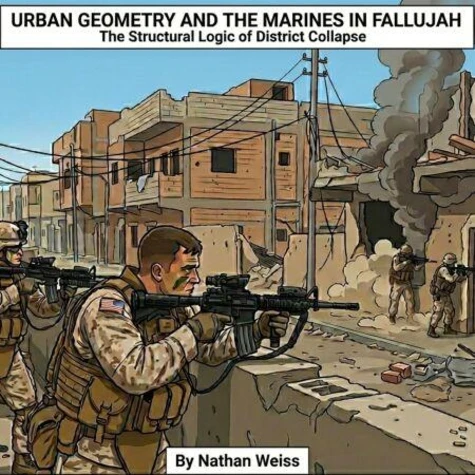
URBAN GEOMETRY AND THE MARINES IN FALLUJAH The Structural Logic of District Collapse
Par :Formats :
Disponible dans votre compte client Decitre ou Furet du Nord dès validation de votre commande. Le format ePub est :
- Compatible avec une lecture sur My Vivlio (smartphone, tablette, ordinateur)
- Compatible avec une lecture sur liseuses Vivlio
- Pour les liseuses autres que Vivlio, vous devez utiliser le logiciel Adobe Digital Edition. Non compatible avec la lecture sur les liseuses Kindle, Remarkable et Sony
 , qui est-ce ?
Notre partenaire de plateforme de lecture numérique où vous retrouverez l'ensemble de vos ebooks gratuitement
Pour en savoir plus sur nos ebooks, consultez notre aide en ligne ici
C'est si simple ! Lisez votre ebook avec l'app Vivlio sur votre tablette, mobile ou ordinateur :

- FormatePub
- ISBN8235142183
- EAN9798235142183
- Date de parution20/04/2026
- Protection num.pas de protection
- Infos supplémentairesepub
- ÉditeurIoakim Ioakim
Résumé
The book traces the battles of Fallujah as a structural system, showing how urban terrain-not chance, emotion, or isolated firefights-determined how the battle unfolded. It explains that every district in the city behaved like a layered defensive organism with its own geometry: exterior rooftops and courtyards for observation, mid-district corridors and stairwells for mobility, and deep interior rooms for final fallback.
As Marines advanced, these layers collapsed in a predictable sequence driven by pressure, tempo, and multi-axis synchronization. The narrative shows how defenders shaped their environment-reinforcing doorways, blocking stairwells, and building protected corridors-and how these structures failed under sustained pressure. Collapse always followed the same pattern: loss of observation, loss of mobility, compression of depth, and finally the breakdown of the last interior node.
Once a district collapsed, Marines reset their geometry, regained mobility and sightlines, and carried momentum into the next district. At the operational level, the book explains how commanders used structural understanding to sequence districts, synchronize axes, and maintain momentum across the city. At the strategic level, it argues that urban warfare is governed by systems: interconnected districts, shared sightlines, and mobility routes that shape defender behavior.
When enough districts collapsed, the defenders' entire system failed-city-wide observation, mobility, and cohesion disappeared. Across 100 chapters, the book reframes Fallujah as a study in geometry, structure, and collapse, revealing that urban warfare follows patterns that can be understood, anticipated, and shaped.
As Marines advanced, these layers collapsed in a predictable sequence driven by pressure, tempo, and multi-axis synchronization. The narrative shows how defenders shaped their environment-reinforcing doorways, blocking stairwells, and building protected corridors-and how these structures failed under sustained pressure. Collapse always followed the same pattern: loss of observation, loss of mobility, compression of depth, and finally the breakdown of the last interior node.
Once a district collapsed, Marines reset their geometry, regained mobility and sightlines, and carried momentum into the next district. At the operational level, the book explains how commanders used structural understanding to sequence districts, synchronize axes, and maintain momentum across the city. At the strategic level, it argues that urban warfare is governed by systems: interconnected districts, shared sightlines, and mobility routes that shape defender behavior.
When enough districts collapsed, the defenders' entire system failed-city-wide observation, mobility, and cohesion disappeared. Across 100 chapters, the book reframes Fallujah as a study in geometry, structure, and collapse, revealing that urban warfare follows patterns that can be understood, anticipated, and shaped.