SOLDES
Jusqu'à -70% sur une sélection d'articles*
Dernière sortie
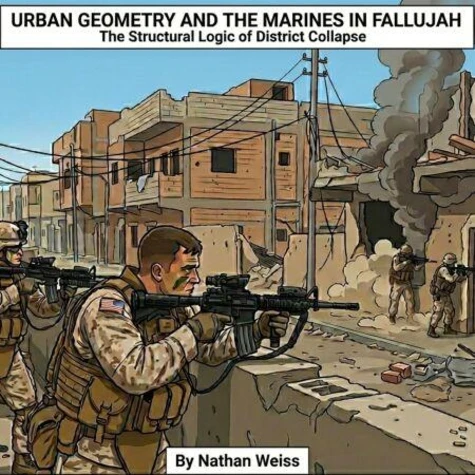
URBAN GEOMETRY AND THE MARINES IN FALLUJAH The Structural Logic of District Collapse
The book traces the battles of Fallujah as a structural system, showing how urban terrain-not chance, emotion, or isolated firefights-determined how the battle unfolded. It explains that every district in the city behaved like a layered defensive organism with its own geometry: exterior rooftops and courtyards for observation, mid-district corridors and stairwells for mobility, and deep interior rooms for final fallback.
As Marines advanced, these layers collapsed in a predictable sequence driven by pressure, tempo, and multi-axis synchronization. The narrative shows how defenders shaped their environment-reinforcing doorways, blocking stairwells, and building protected corridors-and how these structures failed under sustained pressure. Collapse always followed the same pattern: loss of observation, loss of mobility, compression of depth, and finally the breakdown of the last interior node.
Once a district collapsed, Marines reset their geometry, regained mobility and sightlines, and carried momentum into the next district. At the operational level, the book explains how commanders used structural understanding to sequence districts, synchronize axes, and maintain momentum across the city. At the strategic level, it argues that urban warfare is governed by systems: interconnected districts, shared sightlines, and mobility routes that shape defender behavior.
When enough districts collapsed, the defenders' entire system failed-city-wide observation, mobility, and cohesion disappeared. Across 100 chapters, the book reframes Fallujah as a study in geometry, structure, and collapse, revealing that urban warfare follows patterns that can be understood, anticipated, and shaped.
As Marines advanced, these layers collapsed in a predictable sequence driven by pressure, tempo, and multi-axis synchronization. The narrative shows how defenders shaped their environment-reinforcing doorways, blocking stairwells, and building protected corridors-and how these structures failed under sustained pressure. Collapse always followed the same pattern: loss of observation, loss of mobility, compression of depth, and finally the breakdown of the last interior node.
Once a district collapsed, Marines reset their geometry, regained mobility and sightlines, and carried momentum into the next district. At the operational level, the book explains how commanders used structural understanding to sequence districts, synchronize axes, and maintain momentum across the city. At the strategic level, it argues that urban warfare is governed by systems: interconnected districts, shared sightlines, and mobility routes that shape defender behavior.
When enough districts collapsed, the defenders' entire system failed-city-wide observation, mobility, and cohesion disappeared. Across 100 chapters, the book reframes Fallujah as a study in geometry, structure, and collapse, revealing that urban warfare follows patterns that can be understood, anticipated, and shaped.