
Né le 6 mai 1856 en Autriche et mort le 23 septembre 1939 à Londres, nous connaissons Sigmund Freud pour ses nombreux travaux sur la psychanalyse. Après un diplôme de médecine en 1881, il porte un grand intérêt à la neurologie. En 1885, il étudie à Paris en compagnie du professeur Jean-Martin Charcot, célèbre neurologue français. Intrigué par l'hystérie, son premier cas, à son retour à Vienne, est celui d'une jeune femme : Annah O. C'est cette patiente qui donnera à Freud l'occasion de découvrir les bases de sa pensée : la sexualité et le refoulement. En 1897, il débute ses travaux sur les rêves, le fantasme et le célèbre complexe d'œdipe. En 1920, il met à jour les trois instances de l'appareil psychique : le ça, le moi et le surmoi caractérisant chaque individu. Opposé à la pensée de Carl Gustav Jung, il forme des disciples tout au long de sa vie. Encore aujourd'hui, ses œuvres dont Le Malaise dans la civilisation et Introduction à la psychanalyse sont caractérisées comme des ouvrages fondateurs de la discipline psychanalytique. Apprenez-en plus sur ce sujet passionnant et plongez dans les tréfonds de nos âmes. Parmi les auteurs contemporains fascinés par la psychologie humaine ou s'inspirant de la pensée freudienne, nous vous conseillons Boris Cyrulnik avec Sauve-toi, la vie t'appelle ou Michel Onfray et Traité d'athéologie - Physique de la métaphysique. Disponible en plusieurs formats, profitez de notre garantie satisfait ou remboursé pour vous précipiter dans ces lectures captivantes.
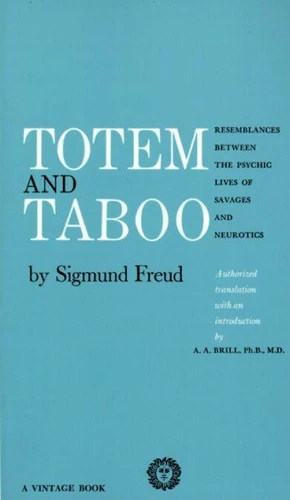
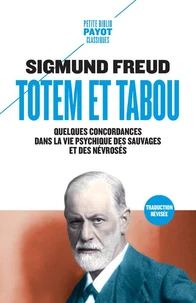
Totem and Taboo. Resemblances Between the Psychic Lives of Savages and Neurotics
Par : ,Formats :
Disponible dans votre compte client Decitre ou Furet du Nord dès validation de votre commande. Le format ePub protégé est :
- Compatible avec une lecture sur My Vivlio (smartphone, tablette, ordinateur)
- Compatible avec une lecture sur liseuses Vivlio
- Pour les liseuses autres que Vivlio, vous devez utiliser le logiciel Adobe Digital Edition. Non compatible avec la lecture sur les liseuses Kindle, Remarkable et Sony
- Non compatible avec un achat hors France métropolitaine
 , qui est-ce ?
Notre partenaire de plateforme de lecture numérique où vous retrouverez l'ensemble de vos ebooks gratuitement
Pour en savoir plus sur nos ebooks, consultez notre aide en ligne ici
C'est si simple ! Lisez votre ebook avec l'app Vivlio sur votre tablette, mobile ou ordinateur :

- Nombre de pages224
- FormatePub
- ISBN978-0-307-81348-0
- EAN9780307813480
- Date de parution04/01/2012
- Protection num.Adobe DRM
- Taille2 Mo
- Infos supplémentairesepub
- ÉditeurVintage
Résumé
In this brilliant exploratory attempt (written in 1912-1913) to extend the analysis of the individual psyche to society and culture, Freud laid the lines for much of his later thought, and made a major contribution to the psychology of religion. Primitive societies and the individual, he found, mutually illuminate each other, and the psychology of primitive races bears marked resemblances to the psychology of neurotics.
Basing his investigations on the findings of the anthropologists, Freud came to the conclusion that totemism and its accompanying restriction of exogamy derive from the savage's dread of incest, and that taboo customs parallel closely the symptoms of compulsion neurosis. The killing of the "primal father" and the consequent sense of guilt are seen as determining events both in the mistry tribal pre-history of mankind, and in the suppressed wishes of individual men.
Both toteism and taboo are thus held to have their roots in the Oedipus complex, which lies at the basis of all neurosis, and, as Freud argues, is also the origin of religion, ethics, society, and art.
Basing his investigations on the findings of the anthropologists, Freud came to the conclusion that totemism and its accompanying restriction of exogamy derive from the savage's dread of incest, and that taboo customs parallel closely the symptoms of compulsion neurosis. The killing of the "primal father" and the consequent sense of guilt are seen as determining events both in the mistry tribal pre-history of mankind, and in the suppressed wishes of individual men.
Both toteism and taboo are thus held to have their roots in the Oedipus complex, which lies at the basis of all neurosis, and, as Freud argues, is also the origin of religion, ethics, society, and art.
A propos de Sigmund Freud
5/5
4/5
10,00 €


3,87 €
3.3/5
3,87 €
4,62 €
3,87 €
3,87 €