James Gleick was born in New York in 1954. He worked for ten years as an editor and reporter for The New York Times. He is the bestselling author of Chaos, Genius, Faster, What Just Happened and a biography of Isaac Newton.
Time Travel
Par :Formats :
Disponible dans votre compte client Decitre ou Furet du Nord dès validation de votre commande. Le format ePub protégé est :
- Compatible avec une lecture sur My Vivlio (smartphone, tablette, ordinateur)
- Compatible avec une lecture sur liseuses Vivlio
- Pour les liseuses autres que Vivlio, vous devez utiliser le logiciel Adobe Digital Edition. Non compatible avec la lecture sur les liseuses Kindle, Remarkable et Sony
- Non compatible avec un achat hors France métropolitaine
 , qui est-ce ?
Notre partenaire de plateforme de lecture numérique où vous retrouverez l'ensemble de vos ebooks gratuitement
Pour en savoir plus sur nos ebooks, consultez notre aide en ligne ici
C'est si simple ! Lisez votre ebook avec l'app Vivlio sur votre tablette, mobile ou ordinateur :

- Nombre de pages352
- FormatePub
- ISBN978-0-00-754444-8
- EAN9780007544448
- Date de parution27/09/2016
- Protection num.Adobe DRM
- Infos supplémentairesepub
- ÉditeurFourth Estate
Résumé
AN OBSERVER BOOK OF THE YEAR
From the acclaimed author of The Information and Chaos, a mind-bending exploration of time travel: its subversive origins, its evolution in literature and science, and its influence on our understanding of time itself.
Gleick's story begins at the turn of the twentieth century with the young H. G. Wells writing and rewriting the fantastic tale that became his first book, an international sensation, The Time Machine.
A host of forces were converging to transmute the human understanding of time, some philosophical and some technological - the electric telegraph, the steam railroad, the discovery of buried civilisations, and the perfection of clocks. Gleick tracks the evolution of time travel as an idea in the culture - from Marcel Proust to Doctor Who, from Woody Allen to Jorge Luis Borges. He explores the inevitable looping paradoxes and examines the porous boundary between pulp fiction and modern physics.
Finally, he delves into a temporal shift that is unsettling our own moment: the instantaneous wired world, with its all-consuming present and vanishing future.
A host of forces were converging to transmute the human understanding of time, some philosophical and some technological - the electric telegraph, the steam railroad, the discovery of buried civilisations, and the perfection of clocks. Gleick tracks the evolution of time travel as an idea in the culture - from Marcel Proust to Doctor Who, from Woody Allen to Jorge Luis Borges. He explores the inevitable looping paradoxes and examines the porous boundary between pulp fiction and modern physics.
Finally, he delves into a temporal shift that is unsettling our own moment: the instantaneous wired world, with its all-consuming present and vanishing future.
A propos de James Gleick

9,90 €

La théorie du chaos
Poche
12,00 €

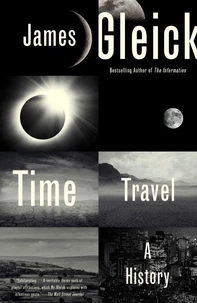
Time Travel. A History
E-book
7,42 €

17,31 €
Isaac Newton
E-book
13,60 €