Md. Uzzal Molla is an independent researcher and theoretical thinker. He earned his MSS degree in Anthropology from the University of Dhaka. His permanent residence is in Gopalganj, Bangladesh. He works on an integrated analysis of the fundamental structure of reality, including laws, events, observers, and moral limits. The central focus of his research is to present the ontological, formal (mathematical), and moral dimensions within a single unified framework. In his professional life, he is a banker, serving as a Senior Principal Officer at Agrani Bank PLC, a bank owned by the Government of Bangladesh.
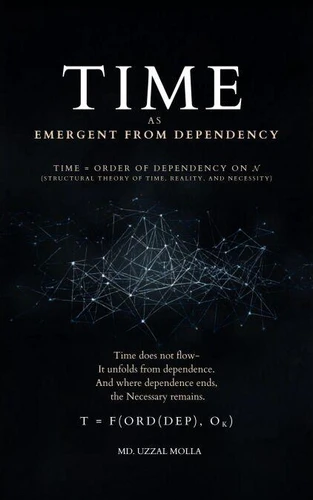
Time as Emergent from Dependency
Par :Formats :
Disponible dans votre compte client Decitre ou Furet du Nord dès validation de votre commande. Le format ePub est :
- Compatible avec une lecture sur My Vivlio (smartphone, tablette, ordinateur)
- Compatible avec une lecture sur liseuses Vivlio
- Pour les liseuses autres que Vivlio, vous devez utiliser le logiciel Adobe Digital Edition. Non compatible avec la lecture sur les liseuses Kindle, Remarkable et Sony
 , qui est-ce ?
Notre partenaire de plateforme de lecture numérique où vous retrouverez l'ensemble de vos ebooks gratuitement
Pour en savoir plus sur nos ebooks, consultez notre aide en ligne ici
C'est si simple ! Lisez votre ebook avec l'app Vivlio sur votre tablette, mobile ou ordinateur :

- FormatePub
- ISBN8235625747
- EAN9798235625747
- Date de parution30/04/2026
- Protection num.pas de protection
- Infos supplémentairesepub
- ÉditeurIoakim Ioakim
Résumé
Time as Emergent from Dependency presents a bold rethinking of one of the most fundamental assumptions in science and philosophy: the nature of time. Instead of treating time as a primary dimension in which reality unfolds, this work argues that time is not fundamental-it is emergent. The central thesis is simple:Time does not carry existence. Time emerges from it. At the foundation of this framework lies dependency (Dep)-a structural relation in which one element exists only if another is ontologically prior.
From this principle, reality is reconstructed not as a temporal sequence, but as a relational structure. To formalize this, the book introduces a unified system:?? = {Li, Ej, Ok, Ml}Where laws, events, observers, and moral constraints form a complete structural field. Within this system, time arises as an ordering of dependency:T = Ord(Dep)T = f(Dep, Ok)Thus, time is not an independent entity but an interpreted ordering of relations, completed through observation.
This leads to several key conclusions: Time does not flow Time is not a dimension Time does not cause change Time is observer-dependent Instead, what we experience as time is the interpretation of structural change: Memory = resolved dependency Future = unresolved dependency Becoming = reconfiguration of relations A central philosophical result is the rejection of infinite regress in dependency chains.
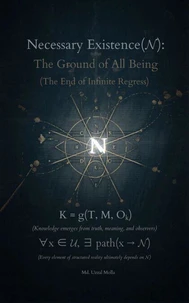
This leads to the necessity of a non-dependent ground:??? such that Dep(??) = ?This ground (??) is not within reality but the condition of its possibility-beyond time, change, and dependency. The full structure can be expressed as:?? ? ?? ? Dep ? Ord(Dep) ? TThis is not a temporal sequence, but a hierarchy of emergence. Ultimately, the book proposes a shift from temporal ontology to structural ontology.
Reality is not something that unfolds in time; rather, time is the final interpretive layer of a deeper relational structure. Reality is not in time. Time is in reality. This work offers a unified framework connecting physics, philosophy, and metaphysics-challenging deeply held assumptions and presenting a coherent alternative grounded in dependency, structure, and necessity.
From this principle, reality is reconstructed not as a temporal sequence, but as a relational structure. To formalize this, the book introduces a unified system:?? = {Li, Ej, Ok, Ml}Where laws, events, observers, and moral constraints form a complete structural field. Within this system, time arises as an ordering of dependency:T = Ord(Dep)T = f(Dep, Ok)Thus, time is not an independent entity but an interpreted ordering of relations, completed through observation.
This leads to several key conclusions: Time does not flow Time is not a dimension Time does not cause change Time is observer-dependent Instead, what we experience as time is the interpretation of structural change: Memory = resolved dependency Future = unresolved dependency Becoming = reconfiguration of relations A central philosophical result is the rejection of infinite regress in dependency chains.
This leads to the necessity of a non-dependent ground:??? such that Dep(??) = ?This ground (??) is not within reality but the condition of its possibility-beyond time, change, and dependency. The full structure can be expressed as:?? ? ?? ? Dep ? Ord(Dep) ? TThis is not a temporal sequence, but a hierarchy of emergence. Ultimately, the book proposes a shift from temporal ontology to structural ontology.
Reality is not something that unfolds in time; rather, time is the final interpretive layer of a deeper relational structure. Reality is not in time. Time is in reality. This work offers a unified framework connecting physics, philosophy, and metaphysics-challenging deeply held assumptions and presenting a coherent alternative grounded in dependency, structure, and necessity.
A propos de Md. Uzzal Molla
1,99 €
1,99 €