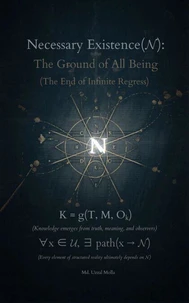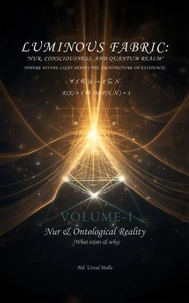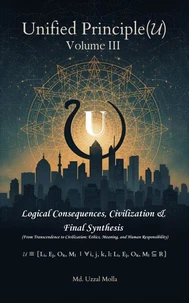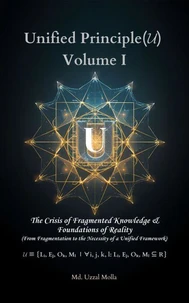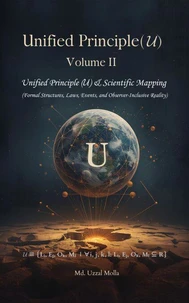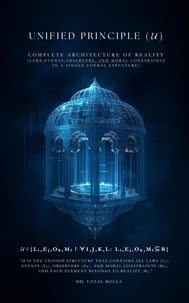
Md. Uzzal Molla is an independent researcher and theoretical thinker. He earned his MSS degree in Anthropology from the University of Dhaka. His permanent residence is in Gopalganj, Bangladesh. He works on an integrated analysis of the fundamental structure of reality, including laws, events, observers, and moral limits. The central focus of his research is to present the ontological, formal (mathematical), and moral dimensions within a single unified framework. In his professional life, he is a banker, serving as a Senior Principal Officer at Agrani Bank PLC, a bank owned by the Government of Bangladesh.
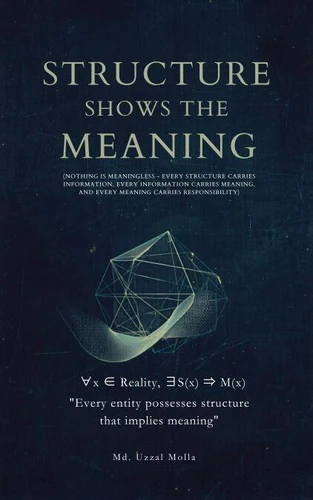
Structure Shows the Meaning
Par :Formats :
Disponible dans votre compte client Decitre ou Furet du Nord dès validation de votre commande. Le format ePub est :
- Compatible avec une lecture sur My Vivlio (smartphone, tablette, ordinateur)
- Compatible avec une lecture sur liseuses Vivlio
- Pour les liseuses autres que Vivlio, vous devez utiliser le logiciel Adobe Digital Edition. Non compatible avec la lecture sur les liseuses Kindle, Remarkable et Sony
 , qui est-ce ?
Notre partenaire de plateforme de lecture numérique où vous retrouverez l'ensemble de vos ebooks gratuitement
Pour en savoir plus sur nos ebooks, consultez notre aide en ligne ici
C'est si simple ! Lisez votre ebook avec l'app Vivlio sur votre tablette, mobile ou ordinateur :

- FormatePub
- ISBN8233793783
- EAN9798233793783
- Date de parution09/04/2026
- Protection num.pas de protection
- Infos supplémentairesepub
- ÉditeurLinda Balsamo
Résumé
Mathematical Description of "Structure Shows the Meaning"This framework presents a formal and unified mathematical articulation of the principle "Structure Shows the Meaning." It establishes that meaning is not arbitrary, but systematically derived from structure through definable functional relationships within reality. At the most fundamental level, the principle is expressed as a direct mapping:S ? M, where Structure (S) gives rise to Meaning (M).
This relationship is further formalized through a functional representation:M = f(S), where f denotes an interpretation function that maps structure to meaning. However, meaning does not emerge in isolation. It is shaped through the interaction between structure and conscious agents. Thus, the model is extended to include observers:M = f(S, Ok), where Ok represents observers. Meaning emerges when structure is interpreted within an observational context.
To achieve a complete representation of reality, the framework is expanded through the Unified Principle (??):?? = {Li, Ej, Ok, Ml}, where Li (Laws) define governing principles, Ej (Events) represent dynamic occurrences, Ok (Observers) enable interpretation, and Ml (Moral constraints) introduce ethical structure. Accordingly, meaning is defined as:M = f(Li, Ej, Ok, Ml). Causality within this system is modeled through temporal evolution:Ej??? = g(Ej?, Li, Ok, Ml), where g represents the causal transformation function, describing how present structures and conditions generate future events.
The framework further establishes that meaning gives rise to value:V = h(M), where h is the valuation function determining significance, importance, or ethical weight. This leads to the structural progression:Structure ? Meaning ? Value. At the highest level, these components integrate to form civilization:C = k(Li, Ej, Ok, Ml), where k represents systemic integration, modeling how structural elements collectively shape societal and civilizational outcomes.
This progression can be summarized as a complete chain:S ? M ? V ? A ? C, where Action (A) emerges from value and contributes to the formation of civilization. In its most compact form, the entire framework is expressed as:C = k(h(f(S, Ok))), indicating that civilization is the result of successive transformations from structure to meaning, meaning to value, and value to systemic realization. At the ontological level, the principle is universally stated as:?x ? Reality, ?S(x) ? M(x), asserting that every entity possesses a structure that implies meaning.
This is reinforced by the necessary condition:¬S ? ¬M, which establishes that without structure, meaning cannot exist.
This relationship is further formalized through a functional representation:M = f(S), where f denotes an interpretation function that maps structure to meaning. However, meaning does not emerge in isolation. It is shaped through the interaction between structure and conscious agents. Thus, the model is extended to include observers:M = f(S, Ok), where Ok represents observers. Meaning emerges when structure is interpreted within an observational context.
To achieve a complete representation of reality, the framework is expanded through the Unified Principle (??):?? = {Li, Ej, Ok, Ml}, where Li (Laws) define governing principles, Ej (Events) represent dynamic occurrences, Ok (Observers) enable interpretation, and Ml (Moral constraints) introduce ethical structure. Accordingly, meaning is defined as:M = f(Li, Ej, Ok, Ml). Causality within this system is modeled through temporal evolution:Ej??? = g(Ej?, Li, Ok, Ml), where g represents the causal transformation function, describing how present structures and conditions generate future events.
The framework further establishes that meaning gives rise to value:V = h(M), where h is the valuation function determining significance, importance, or ethical weight. This leads to the structural progression:Structure ? Meaning ? Value. At the highest level, these components integrate to form civilization:C = k(Li, Ej, Ok, Ml), where k represents systemic integration, modeling how structural elements collectively shape societal and civilizational outcomes.
This progression can be summarized as a complete chain:S ? M ? V ? A ? C, where Action (A) emerges from value and contributes to the formation of civilization. In its most compact form, the entire framework is expressed as:C = k(h(f(S, Ok))), indicating that civilization is the result of successive transformations from structure to meaning, meaning to value, and value to systemic realization. At the ontological level, the principle is universally stated as:?x ? Reality, ?S(x) ? M(x), asserting that every entity possesses a structure that implies meaning.
This is reinforced by the necessary condition:¬S ? ¬M, which establishes that without structure, meaning cannot exist.
A propos de Md. Uzzal Molla
1,99 €
1,99 €