
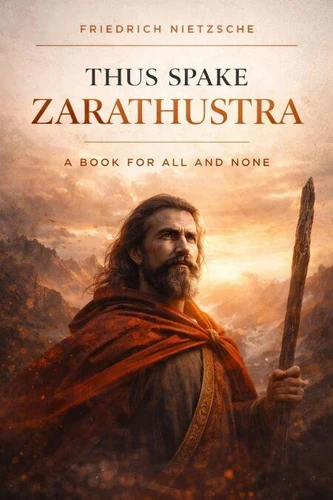
Friedrich Wilhelm Nietzsche (1844-1900) was a German philosopher, classical philologist, and cultural critic whose work has had a profound impact on modern Western philosophy, literature, and psychology. His writings are known for their aphoristic style, scathing critique of traditional morality, religion, and philosophy, and his exploration of concepts such as "God is dead, " the Übermensch (superman), the will to power, and eternal recurrence.
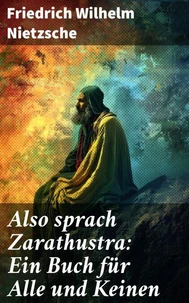
Thus Spoke Zarathustra. A Book for Everyone and No One
Par :Formats :
Disponible dans votre compte client Decitre ou Furet du Nord dès validation de votre commande. Le format ePub est :
- Compatible avec une lecture sur My Vivlio (smartphone, tablette, ordinateur)
- Compatible avec une lecture sur liseuses Vivlio
- Pour les liseuses autres que Vivlio, vous devez utiliser le logiciel Adobe Digital Edition. Non compatible avec la lecture sur les liseuses Kindle, Remarkable et Sony
 , qui est-ce ?
Notre partenaire de plateforme de lecture numérique où vous retrouverez l'ensemble de vos ebooks gratuitement
Pour en savoir plus sur nos ebooks, consultez notre aide en ligne ici
C'est si simple ! Lisez votre ebook avec l'app Vivlio sur votre tablette, mobile ou ordinateur :

- Nombre de pages415
- FormatePub
- ISBN978-3-8190-0735-4
- EAN9783819007354
- Date de parution13/03/2026
- Protection num.Digital Watermarking
- Taille912 Ko
- Infos supplémentairesepub
- Éditeurepubli
Résumé
Thus Spoke Zarathustra (German: Also sprach Zarathustra, sometimes translated Thus Spake Zarathustra), subtitled A Book for All and None (Ein Buch für Alle und Keinen), is a written work by German philosopher Friedrich Nietzsche, composed in four parts between 1883 and 1885. Much of the work deals with ideas such as the "eternal recurrence of the same", the parable on the "death of God", and the "prophecy" of the Overman, which were first introduced in The Gay Science.
Described by Nietzsche himself as "the deepest ever written", the book is a dense and esoteric treatise on philosophy and morality, featuring as protagonist a fictionalized Zarathustra. A central irony of the text is that the style of the Bible is used by Nietzsche to present ideas of his which fundamentally oppose Judaeo-Christian morality and tradition.
Described by Nietzsche himself as "the deepest ever written", the book is a dense and esoteric treatise on philosophy and morality, featuring as protagonist a fictionalized Zarathustra. A central irony of the text is that the style of the Bible is used by Nietzsche to present ideas of his which fundamentally oppose Judaeo-Christian morality and tradition.
A propos de Friedrich Wilhelm Nietzsche
Beyond Good and Evil
E-book
0,99 €
6,49 €
9,99 €


1,99 €
6,49 €

11,99 €
Götzen-Dämmerung
E-book
7,49 €


Zur Genealogie der Moral
E-book
4,49 €
Also sprach Zarathustra
E-book
5,49 €

Thus Spake Zarathustra
E-book
5,99 €
The Antichrist
E-book
2,49 €