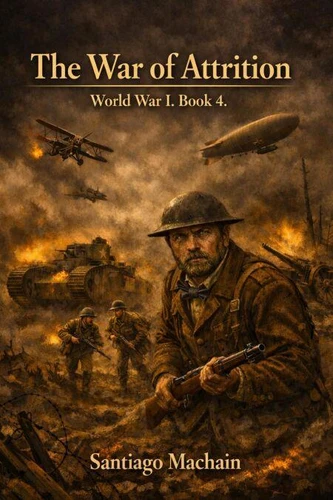
The War of Attrition. World War I, #4
Par :Formats :
Disponible dans votre compte client Decitre ou Furet du Nord dès validation de votre commande. Le format ePub est :
- Compatible avec une lecture sur My Vivlio (smartphone, tablette, ordinateur)
- Compatible avec une lecture sur liseuses Vivlio
- Pour les liseuses autres que Vivlio, vous devez utiliser le logiciel Adobe Digital Edition. Non compatible avec la lecture sur les liseuses Kindle, Remarkable et Sony
 , qui est-ce ?
Notre partenaire de plateforme de lecture numérique où vous retrouverez l'ensemble de vos ebooks gratuitement
Pour en savoir plus sur nos ebooks, consultez notre aide en ligne ici
C'est si simple ! Lisez votre ebook avec l'app Vivlio sur votre tablette, mobile ou ordinateur :

- FormatePub
- ISBN8235471061
- EAN9798235471061
- Date de parution14/05/2026
- Protection num.pas de protection
- Infos supplémentairesepub
- ÉditeurIoakim Ioakim
Résumé
The War of Attrition explores the year World War I became a brutal contest of endurance, industry, morale, and national survival. From the blood-soaked fields of Verdun and the Somme to the naval clash at Jutland and the dramatic Brusilov Offensive on the Eastern Front, this volume reveals how 1916 pushed armies and civilians to the edge of collapse. This forth book goes beyond battlefield movements to show how modern war consumed entire societies.
Soldiers faced artillery, mud, wire, tanks, and exhaustion, while civilians endured hunger, grief, shortages, propaganda, occupation, and the growing pressure of total war. By the end of 1916, no nation had achieved victory, but the balance had begun to shift. The Central Powers remained dangerous, yet Britain, France, Russia, and their allies were slowly changing the direction of the conflict through sacrifice, pressure, and endurance.
Soldiers faced artillery, mud, wire, tanks, and exhaustion, while civilians endured hunger, grief, shortages, propaganda, occupation, and the growing pressure of total war. By the end of 1916, no nation had achieved victory, but the balance had begun to shift. The Central Powers remained dangerous, yet Britain, France, Russia, and their allies were slowly changing the direction of the conflict through sacrifice, pressure, and endurance.
A propos de Santiago Machain



7,99 €


7,99 €
7,99 €

7,99 €
7,99 €

6,99 €