Nouveauté
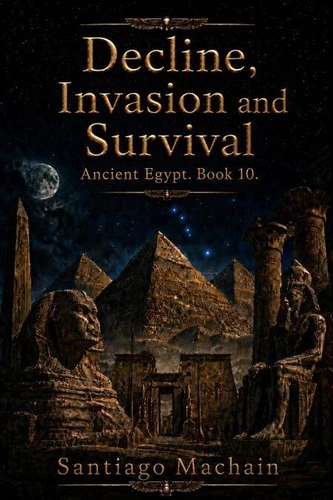
Decline, Invasion and Survival. Ancient Egypt, #10
Par :Formats :
Disponible dans votre compte client Decitre ou Furet du Nord dès validation de votre commande. Le format ePub est :
- Compatible avec une lecture sur My Vivlio (smartphone, tablette, ordinateur)
- Compatible avec une lecture sur liseuses Vivlio
- Pour les liseuses autres que Vivlio, vous devez utiliser le logiciel Adobe Digital Edition. Non compatible avec la lecture sur les liseuses Kindle, Remarkable et Sony
 , qui est-ce ?
Notre partenaire de plateforme de lecture numérique où vous retrouverez l'ensemble de vos ebooks gratuitement
Pour en savoir plus sur nos ebooks, consultez notre aide en ligne ici
C'est si simple ! Lisez votre ebook avec l'app Vivlio sur votre tablette, mobile ou ordinateur :

- FormatePub
- ISBN8235759268
- EAN9798235759268
- Date de parution24/08/2026
- Protection num.pas de protection
- Infos supplémentairesepub
- ÉditeurIoakim Ioakim
Résumé
Decline, Invasion, and Survival follows Egypt through one of the most turbulent periods in its long history, when the power of the New Kingdom faded and the civilization of the pharaohs was forced to confront economic crisis, political division, foreign dynasties, and invasion. Beginning with the uncertain world that followed Ramesses II, the book traces the reign of Ramesses III, the devastating arrival of the Sea Peoples, and the last great military victories of the New Kingdom.
It explores the magnificent temple of Medinet Habu, the growing economic crisis, the first recorded workers' strikes, widespread tomb robbery, and the increasing power of the Priests of Amun as royal authority weakened. As Egypt fragmented, Libyan families rose from military settlers to pharaohs, while the kings of Kush marched north and reunited the country under the Twenty-Fifth Dynasty. Their revival brought Egypt into direct conflict with the expanding Assyrian Empire, culminating in invasion and the dramatic sack of Thebes.
From this destruction emerged the Saite Dynasty, whose rulers restored political unity, revived ancient artistic traditions, encouraged Mediterranean commerce, and brought Egypt into closer contact with the Greek world. Yet beyond the eastern frontier, an even greater empire was rising. With Persia approaching, Egypt stood at the threshold of another transformation. This volume tells the story not simply of decline, but of an extraordinary civilization repeatedly adapting to crisis, absorbing foreign rulers, restoring its traditions, and surviving long after the empire of the great warrior pharaohs had disappeared.
It explores the magnificent temple of Medinet Habu, the growing economic crisis, the first recorded workers' strikes, widespread tomb robbery, and the increasing power of the Priests of Amun as royal authority weakened. As Egypt fragmented, Libyan families rose from military settlers to pharaohs, while the kings of Kush marched north and reunited the country under the Twenty-Fifth Dynasty. Their revival brought Egypt into direct conflict with the expanding Assyrian Empire, culminating in invasion and the dramatic sack of Thebes.
From this destruction emerged the Saite Dynasty, whose rulers restored political unity, revived ancient artistic traditions, encouraged Mediterranean commerce, and brought Egypt into closer contact with the Greek world. Yet beyond the eastern frontier, an even greater empire was rising. With Persia approaching, Egypt stood at the threshold of another transformation. This volume tells the story not simply of decline, but of an extraordinary civilization repeatedly adapting to crisis, absorbing foreign rulers, restoring its traditions, and surviving long after the empire of the great warrior pharaohs had disappeared.
A propos de Santiago Machain
7,99 €
7,99 €
7,99 €
7,99 €
7,99 €


6,99 €


6,99 €
7,99 €