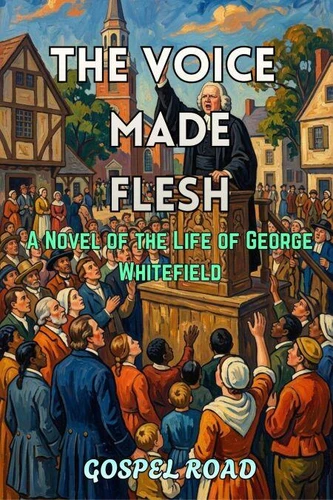
The Voice Made Flesh tells the story of George Whitefield (1714-1770), the English evangelist who became one of the most electrifying preachers of the eighteenth century. Born into poverty as the son of an innkeeper in Gloucester, England, Whitefield discovered early that his voice had the power to hold a room still - a gift he would carry across two continents and thirteen Atlantic crossings before his death at fifty-six.
The novel follows Whitefield from his boyhood at the Bell Inn, through his conversion experience at Oxford's Holy Club alongside John and Charles Wesley, to his groundbreaking decision to take the gospel out of church buildings entirely and preach in open fields, harbor fronts, and city squares. In the coal-mining district of Kingswood, Bristol, he stood on a hillside and watched tears cut white channels through the blackened faces of miners who had never once set foot inside a church.
That image never left him. The story moves across the Atlantic with him, tracing his deep friendship with Benjamin Franklin - a skeptic who never converted but never stopped being moved - his founding of the Bethesda orphanage in Georgia, and his role in the First Great Awakening, the religious revival that helped shape the spiritual and political identity of colonial America. He preached before thirty thousand people on Boston Common at a time when the city's total population was twenty thousand.
But this is equally a novel about the interior life behind the public voice. About the theological rupture with John Wesley over predestination, a split that cost more than an argument. About a quiet marriage to Elizabeth James, whose steady presence George only fully understood when she was gone. About the death of an infant son. About the compromises he made - most painfully, his silence on the institution of slavery - and the long tension between the man he believed he was called to be and the man he sometimes was.
The Voice Made Flesh asks what it costs to give your life entirely to a single direction, and whether a voice that dissolves into the air leaves anything behind. The answer, this novel suggests, is that it does - long after the speaker has gone quiet.
The Voice Made Flesh tells the story of George Whitefield (1714-1770), the English evangelist who became one of the most electrifying preachers of the eighteenth century. Born into poverty as the son of an innkeeper in Gloucester, England, Whitefield discovered early that his voice had the power to hold a room still - a gift he would carry across two continents and thirteen Atlantic crossings before his death at fifty-six.
The novel follows Whitefield from his boyhood at the Bell Inn, through his conversion experience at Oxford's Holy Club alongside John and Charles Wesley, to his groundbreaking decision to take the gospel out of church buildings entirely and preach in open fields, harbor fronts, and city squares. In the coal-mining district of Kingswood, Bristol, he stood on a hillside and watched tears cut white channels through the blackened faces of miners who had never once set foot inside a church.
That image never left him. The story moves across the Atlantic with him, tracing his deep friendship with Benjamin Franklin - a skeptic who never converted but never stopped being moved - his founding of the Bethesda orphanage in Georgia, and his role in the First Great Awakening, the religious revival that helped shape the spiritual and political identity of colonial America. He preached before thirty thousand people on Boston Common at a time when the city's total population was twenty thousand.
But this is equally a novel about the interior life behind the public voice. About the theological rupture with John Wesley over predestination, a split that cost more than an argument. About a quiet marriage to Elizabeth James, whose steady presence George only fully understood when she was gone. About the death of an infant son. About the compromises he made - most painfully, his silence on the institution of slavery - and the long tension between the man he believed he was called to be and the man he sometimes was.
The Voice Made Flesh asks what it costs to give your life entirely to a single direction, and whether a voice that dissolves into the air leaves anything behind. The answer, this novel suggests, is that it does - long after the speaker has gone quiet.

 , qui est-ce ?