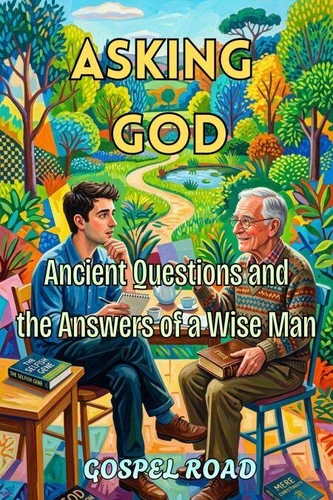
Asking God follows Ethan, a twenty-six-year-old from Concord, Massachusetts, who finds himself spiritually adrift in Boston - caught between the faith of his childhood and the questions that drove him away from it. Over the course of a New England winter, he meets a quietly learned stranger he comes to call the Wise Man, and the two begin a series of unhurried conversations in coffee shops, bookstores, and along the frozen banks of the Charles River.
Their dialogue moves through twenty of the oldest and hardest questions raised against Christian faith - the problem of evil, the silence of God, the violence of Scripture, the justice of hell, the historicity of the resurrection, and more. The Wise Man never deflects, never offers easy comfort, and never asks Ethan simply to believe. Instead, he thinks alongside him - drawing on philosophy, history, and theology - while acknowledging, with honesty, the questions that remain open.
Written in the quiet, reflective style of literary fiction, Asking God is not an apologetics textbook dressed in narrative clothing. It is a book about what it means to ask seriously, to sit with uncertainty, and to keep walking anyway - through a Boston winter that, by the final page, is just beginning to thaw.
Asking God follows Ethan, a twenty-six-year-old from Concord, Massachusetts, who finds himself spiritually adrift in Boston - caught between the faith of his childhood and the questions that drove him away from it. Over the course of a New England winter, he meets a quietly learned stranger he comes to call the Wise Man, and the two begin a series of unhurried conversations in coffee shops, bookstores, and along the frozen banks of the Charles River.
Their dialogue moves through twenty of the oldest and hardest questions raised against Christian faith - the problem of evil, the silence of God, the violence of Scripture, the justice of hell, the historicity of the resurrection, and more. The Wise Man never deflects, never offers easy comfort, and never asks Ethan simply to believe. Instead, he thinks alongside him - drawing on philosophy, history, and theology - while acknowledging, with honesty, the questions that remain open.
Written in the quiet, reflective style of literary fiction, Asking God is not an apologetics textbook dressed in narrative clothing. It is a book about what it means to ask seriously, to sit with uncertainty, and to keep walking anyway - through a Boston winter that, by the final page, is just beginning to thaw.

 , qui est-ce ?