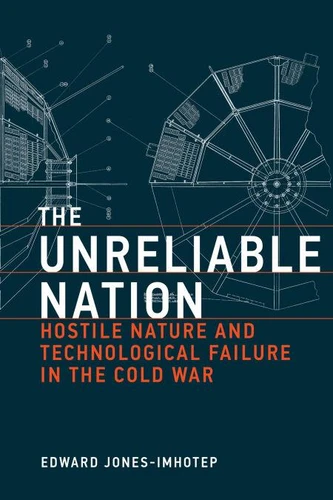
The Unreliable Nation. Hostile Nature and Technological Failure in the Cold War
Par :Formats :
Disponible dans votre compte client Decitre ou Furet du Nord dès validation de votre commande. Le format ePub protégé est :
- Compatible avec une lecture sur My Vivlio (smartphone, tablette, ordinateur)
- Compatible avec une lecture sur liseuses Vivlio
- Pour les liseuses autres que Vivlio, vous devez utiliser le logiciel Adobe Digital Edition. Non compatible avec la lecture sur les liseuses Kindle, Remarkable et Sony
- Non compatible avec un achat hors France métropolitaine
 , qui est-ce ?
Notre partenaire de plateforme de lecture numérique où vous retrouverez l'ensemble de vos ebooks gratuitement
Pour en savoir plus sur nos ebooks, consultez notre aide en ligne ici
C'est si simple ! Lisez votre ebook avec l'app Vivlio sur votre tablette, mobile ou ordinateur :

- Nombre de pages312
- FormatePub
- ISBN978-0-262-34132-5
- EAN9780262341325
- Date de parution25/08/2017
- Protection num.Adobe DRM
- Taille51 Mo
- Infos supplémentairesepub
- ÉditeurThe MIT Press
Résumé
An examination of how technological failures defined nature and national identity in Cold War Canada. Throughout the modern period, nations defined themselves through the relationship between nature and machines. Many cast themselves as a triumph of technology over the forces of climate, geography, and environment. Some, however, crafted a powerful alternative identity: they defined themselves not through the triumph of machines over nature, but through technological failures and the distinctive natural orders that caused them.
In The Unreliable Nation, Edward Jones-Imhotep examines one instance in this larger history: the Cold War-era project to extend reliable radio communications to the remote and strategically sensitive Canadian North. He argues that, particularly at moments when countries viewed themselves as marginal or threatened, the identity of the modern nation emerged as a scientifically articulated relationship between distinctive natural phenomena and the problematic behaviors of complex groups of machines.
Drawing on previously unpublished archival documents and recently declassified materials, Jones-Imhotep shows how Canadian defense scientists elaborated a distinctive "Northern" natural order of violent ionospheric storms and auroral displays, and linked it to a "machinic order" of severe and widespread radio disruptions throughout the country. Tracking their efforts through scientific images, experimental satellites, clandestine maps, and machine architectures, he argues that these scientists naturalized Canada's technological vulnerabilities as part of a program to reimagine the postwar nation.
The real and potential failures of machines came to define Canada, its hostile Northern nature, its cultural anxieties, and its geo-political vulnerabilities during the early Cold War. Jones-Imhotep's study illustrates the surprising role of technological failures in shaping contemporary understandings of both nature and nation.
In The Unreliable Nation, Edward Jones-Imhotep examines one instance in this larger history: the Cold War-era project to extend reliable radio communications to the remote and strategically sensitive Canadian North. He argues that, particularly at moments when countries viewed themselves as marginal or threatened, the identity of the modern nation emerged as a scientifically articulated relationship between distinctive natural phenomena and the problematic behaviors of complex groups of machines.
Drawing on previously unpublished archival documents and recently declassified materials, Jones-Imhotep shows how Canadian defense scientists elaborated a distinctive "Northern" natural order of violent ionospheric storms and auroral displays, and linked it to a "machinic order" of severe and widespread radio disruptions throughout the country. Tracking their efforts through scientific images, experimental satellites, clandestine maps, and machine architectures, he argues that these scientists naturalized Canada's technological vulnerabilities as part of a program to reimagine the postwar nation.
The real and potential failures of machines came to define Canada, its hostile Northern nature, its cultural anxieties, and its geo-political vulnerabilities during the early Cold War. Jones-Imhotep's study illustrates the surprising role of technological failures in shaping contemporary understandings of both nature and nation.