SOLDES
Jusqu'à -70% sur une sélection d'articles*

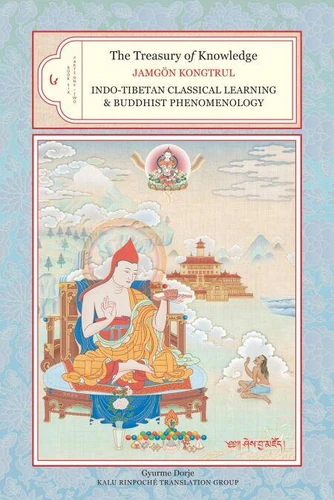
The Treasury of Knowledge: Book Six, Parts One and Two. Indo-Tibetan Classical Learning and Buddhist Phenomenology
Par : ,Formats :
Disponible dans votre compte client Decitre ou Furet du Nord dès validation de votre commande. Le format ePub protégé est :
- Compatible avec une lecture sur My Vivlio (smartphone, tablette, ordinateur)
- Compatible avec une lecture sur liseuses Vivlio
- Pour les liseuses autres que Vivlio, vous devez utiliser le logiciel Adobe Digital Edition. Non compatible avec la lecture sur les liseuses Kindle, Remarkable et Sony
- Non compatible avec un achat hors France métropolitaine
 , qui est-ce ?
Notre partenaire de plateforme de lecture numérique où vous retrouverez l'ensemble de vos ebooks gratuitement
Pour en savoir plus sur nos ebooks, consultez notre aide en ligne ici
C'est si simple ! Lisez votre ebook avec l'app Vivlio sur votre tablette, mobile ou ordinateur :

- Nombre de pages992
- FormatePub
- ISBN978-1-55939-731-5
- EAN9781559397315
- Date de parution08/01/2013
- Protection num.Adobe DRM
- Taille14 Mo
- Infos supplémentairesepub
- ÉditeurSnow Lion
Résumé
Jamgön Kongtrul's encyclopedic Treasury of Knowledge presents a complete account of the major lines of thought and practice that comprise Tibetan Buddhism. Among the ten books that make up this tour de force, Book Six is by far the longest-concisely summarizing the theoretical fields of knowledge to be studied prior to the cultivation of reflection and discriminative awareness. The first two parts of Book Six, contained in this volume, respectively concern Indo-Tibetan classical learning and Buddhist phenomenology.
The former analyzes the traditional subjects of phonology and Sanskrit grammar, logic, fine art, and medicine, along with astrology, poetics, prosody, synonymics, and dramaturgy. The principal non-Buddhist philosophical systems of ancient India are then summarized and contrasted with the hierarchical meditative concentrations and formless absorptions through which the "summit of cyclic existence" can genuinely be attained.
Part Two examines the phenomenological structures of Abhidharma-the shared inheritance of all Buddhist traditions-from three distinct perspectives, corresponding to the three successive turnings of the doctrinal wheel.
The former analyzes the traditional subjects of phonology and Sanskrit grammar, logic, fine art, and medicine, along with astrology, poetics, prosody, synonymics, and dramaturgy. The principal non-Buddhist philosophical systems of ancient India are then summarized and contrasted with the hierarchical meditative concentrations and formless absorptions through which the "summit of cyclic existence" can genuinely be attained.
Part Two examines the phenomenological structures of Abhidharma-the shared inheritance of all Buddhist traditions-from three distinct perspectives, corresponding to the three successive turnings of the doctrinal wheel.