SOLDES
Jusqu'à -70% sur une sélection d'articles*

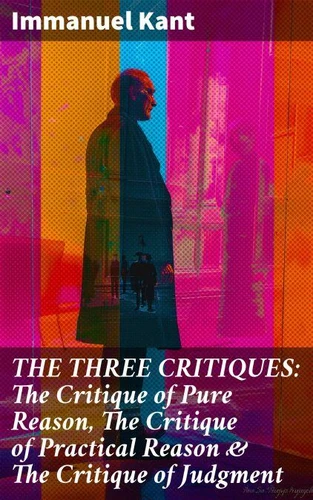
THE THREE CRITIQUES: The Critique of Pure Reason, The Critique of Practical Reason & The Critique of Judgment. Foundational Insights into Ethics and Aesthetics
Par : , , ,Formats :
Disponible dans votre compte client Decitre ou Furet du Nord dès validation de votre commande. Le format ePub est :
- Compatible avec une lecture sur My Vivlio (smartphone, tablette, ordinateur)
- Compatible avec une lecture sur liseuses Vivlio
- Pour les liseuses autres que Vivlio, vous devez utiliser le logiciel Adobe Digital Edition. Non compatible avec la lecture sur les liseuses Kindle, Remarkable et Sony
 , qui est-ce ?
Notre partenaire de plateforme de lecture numérique où vous retrouverez l'ensemble de vos ebooks gratuitement
Pour en savoir plus sur nos ebooks, consultez notre aide en ligne ici
C'est si simple ! Lisez votre ebook avec l'app Vivlio sur votre tablette, mobile ou ordinateur :

- Nombre de pages1050
- FormatePub
- ISBN859-65--4780494-9
- EAN8596547804949
- Date de parution08/01/2024
- Protection num.Digital Watermarking
- Taille1 Mo
- Infos supplémentairesepub
- ÉditeurGOOD PRESS
Résumé
In "The Three Critiques: The Critique of Pure Reason, The Critique of Practical Reason, and The Critique of Judgment, " Immanuel Kant presents a groundbreaking exploration of epistemology, ethics, and aesthetics, fundamentally reshaping Western philosophy. Each critique acts as a pillar in Kant's critical philosophy, addressing the limits of human understanding, the nature of moral judgment, and the conditions for aesthetic appreciation.
The texts are marked by a rigorous analytic style, replete with intricate arguments and foundational concepts such as the categorical imperative and the aesthetic sublime that anchor Kant's transcendental idealism within both metaphysics and human experience. Immanuel Kant (1724-1804), a pivotal figure in Enlightenment thought, was profoundly influenced by the philosophical debates of his time, especially regarding the nature of knowledge and morality.
His engagement with rationalism and empiricism led to his distinct method of critical examination, seeking to resolve the tensions between subjective experience and objective reality. The challenges posed by skepticism and dogmatism drove Kant to develop a comprehensive framework that articulated the relationship between reason, will, and the aesthetic experience. Scholars and readers alike will find "The Three Critiques" indispensable for understanding modern philosophy's emergence.
With clarity and depth, Kant'Äôs works not only provide a robust foundation for ethical and aesthetic inquiry but also challenge readers to contemplate their own cognitive capacities and moral responsibilities. This collection is essential for anyone seeking insight into the philosophical currents that define contemporary thought.
The texts are marked by a rigorous analytic style, replete with intricate arguments and foundational concepts such as the categorical imperative and the aesthetic sublime that anchor Kant's transcendental idealism within both metaphysics and human experience. Immanuel Kant (1724-1804), a pivotal figure in Enlightenment thought, was profoundly influenced by the philosophical debates of his time, especially regarding the nature of knowledge and morality.
His engagement with rationalism and empiricism led to his distinct method of critical examination, seeking to resolve the tensions between subjective experience and objective reality. The challenges posed by skepticism and dogmatism drove Kant to develop a comprehensive framework that articulated the relationship between reason, will, and the aesthetic experience. Scholars and readers alike will find "The Three Critiques" indispensable for understanding modern philosophy's emergence.
With clarity and depth, Kant'Äôs works not only provide a robust foundation for ethical and aesthetic inquiry but also challenge readers to contemplate their own cognitive capacities and moral responsibilities. This collection is essential for anyone seeking insight into the philosophical currents that define contemporary thought.